Short answer: Chinchero is an Andean town about 30 km from Cusco (roughly 1 hour by car), on a high plateau at about 3,760 m, on the road to Maras, Moray and Urubamba. The highlights are its colonial church built on Inca walls, the terraces of the archaeological site (entry with the Cusco Tourist Ticket) and the weaving centers with natural dye demonstrations; Sunday is usually the biggest market day. One to two hours is enough to see it well, and a Viajes D’MARC private taxi from your hotel costs from US$26 (S/ 90) per vehicle.
What Chinchero is and why it’s worth a visit
Chinchero is a Quechua town of adobe houses and cobbled lanes, surrounded by fields of potatoes, fava beans and barley that roll across the plateau toward the snowcapped Urubamba range. It isn’t down on the Sacred Valley floor but on the high tableland between Cusco and the valley, so almost everyone taking the short road from Cusco to Urubamba or Ollantaytambo drives through it.
Tradition attributes a royal estate here to Túpac Inca Yupanqui, son and successor of Pachacútec. Fine stone walls, terraces and carved rocks survive from it. What really sets Chinchero apart, though, is that it is still a working town: many families live from farming and weaving, and traditional dress is everyday wear, not a costume for visitors.
What to see in Chinchero
The main square and its Inca niche wall
One side of the main square is lined by a long, well-preserved Inca wall with large trapezoidal niches. From the square you get a wide view over the plateau and, on clear days, the snow peaks on the horizon.
The colonial church
It was built early in the colonial period directly on top of Inca walls, which you can still see at its base. The outside is plain adobe and stone; the inside is a surprise, with walls and ceilings covered in floral and religious paintings and canvases in the Cusco School style. Photos and video are usually not allowed inside, so take your time looking and follow the staff’s instructions. It’s a working church: if Mass is on, wait or slip in quietly.
The terraces and archaeological site
Below the church, Inca terraces step down the hillside, with stone stairways and views toward the valley. The paths are uneven with plenty of steps: nothing difficult, but you will feel every climb at this altitude. Look out for the carved rocks the Incas treated as sacred places.
Weaving centers and natural dye demonstrations
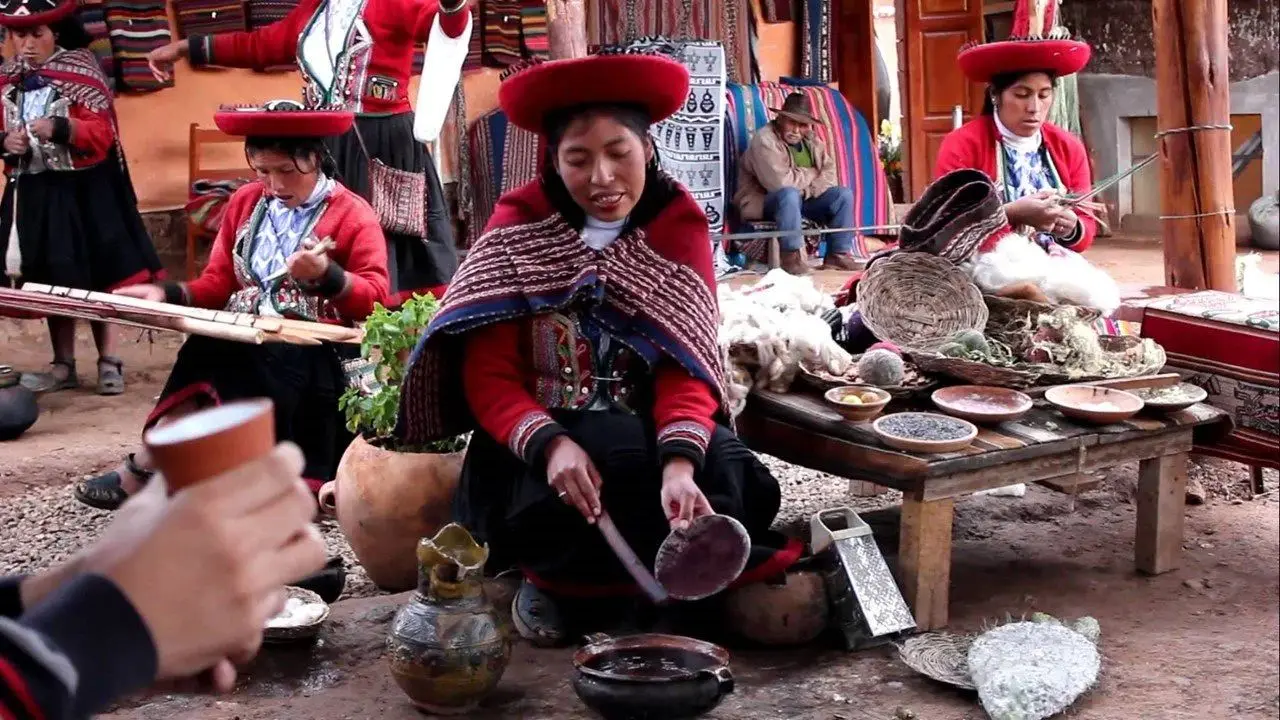
Chinchero is famous for its textiles. Several weaving centers and cooperatives in town walk you through the whole process in about 20 to 30 minutes: washing sheep or alpaca wool with a root that lathers like soap, dyeing it with plants, minerals and cochineal (the insect behind the deep reds and purples), and weaving local patterns on backstrap looms. The demonstration is usually free and afterwards you can buy straight from the weavers.
The market
There are craft stalls on the square most days, but the biggest, liveliest market is usually on Sunday, when families from nearby communities bring potatoes, corn, beans and other produce; at some stalls you may still see bartering. On weekdays it is far quieter. Size and hours vary through the year.
Around town: Lake Piuray and the new airport
A few minutes from town lies Lake Piuray (Laguna de Piuray), ringed by farmland and villages; with a private car you can stop briefly for photos. On the nearby plateau the new Chinchero international airport is under construction and is planned to replace Cusco’s current airport; until it opens, all flights still land at the city airport (see our Cusco airport guide).
Tickets: the Cusco Tourist Ticket
- Entry to the archaeological complex, which includes the church and terraces, is checked against the Cusco Tourist Ticket (Boleto Turístico): either the full ticket or the partial circuit III ticket, which also covers Pisac, Ollantaytambo and Moray. Check at the gate what your ticket includes.
- Buy it in Cusco before you go and carry your passport. Ticket types, validity and where to buy are in our Cusco Tourist Ticket guide.
- The circuit III ticket is only valid for a few days, so fit in Pisac, Ollantaytambo or Moray within that window.
- The town, the square and the weaving demonstrations need no ticket.
How to get from Cusco to Chinchero
The road leaves Cusco to the northwest, climbs with views back over the city and reaches the Chinchero plateau in about an hour. Your options:
| Option | Approx. time | Pros | Cons | Best for |
|---|---|---|---|---|
| Viajes D’MARC private taxi | 1h | Hotel pick-up, just your group, can wait or continue to the valley | Priced per vehicle | Couples, families and anyone with luggage |
| Cusco–Urubamba colectivo | 1h + waiting | Very cheap | You go to the stop, little room for bags | Solo travelers with a small pack |
| Shared Sacred Valley tour | Full day | Priced per person, all organized | Short stop, often late in the afternoon | Travelers with no time to plan |
| Private Chinchero, Maras, Moray & Ollantaytambo tour | Full day | Your own pace, can end at the train station | Long day | Anyone sleeping in the valley or heading to Machu Picchu |
Colectivo: shared minivans from Cusco to Urubamba via Chinchero leave from around Calle Pavitos (check the current stop with your hotel, as it moves); ask to get off in Chinchero.
Private taxi: the listed price is one way; if you’d like the driver to wait and then take you back or on to the valley, ask when booking and we’ll confirm the price. If you’re sleeping in the valley, the Cusco to Urubamba taxi can include a stop in Chinchero.
How much time you need, step by step
| Plan | Approx. time | What you’ll see |
|---|---|---|
| Quick stop | 45 min – 1h | Square, church and a weaving demonstration |
| Full visit | 2 – 3h | All of the above plus the terraces and market at leisure |
| Half day from Cusco | 4 – 5h round trip | Full visit plus a stop at Lake Piuray |
| Combined day | 8 – 10h | Chinchero, Maras, Moray and Ollantaytambo |
- The day before: buy your Tourist Ticket and get soles in cash, in small notes.
- Leave Cusco early (8:00–8:30 a.m.). You arrive while the town is quiet, ahead of many shared tours, which tend to come through in the afternoon.
- Square and church first (about 30 min).
- Walk down the terraces at your own pace and climb back up slowly.
- Weaving demonstration: pick one center, watch the whole process and only buy if something catches your eye.
- Market or lunch: on Sunday, wander the produce area; otherwise there are simple restaurants near the square.
Combining Chinchero with Maras, Moray, Urubamba and Ollantaytambo
Chinchero is the natural first stop on the short road to the Sacred Valley:
- Chinchero + Maras and Moray: the Maras turn-off is a short drive across the plateau, and Moray and the Salt Mines are about 30–40 minutes from Chinchero. Read our Maras and Moray guide or book the Maras & Moray tour with a stop in Chinchero.
- Full day ending in Ollantaytambo: the Chinchero, Maras, Moray & Ollantaytambo tour finishes in Ollantaytambo, ideal if you’re catching the train to Machu Picchu. For what to see there, read our Ollantaytambo guide.
- Staying in Urubamba: from Chinchero the road drops to the valley in about 30–40 minutes. See our Cusco to Urubamba guide.
- Classic Sacred Valley: the Sacred Valley VIP tour links Pisac, Urubamba, Ollantaytambo and Chinchero in one day.
Altitude, weather and the best time to go
- Altitude: Chinchero sits at about 3,760 m, roughly 350 m higher than Cusco and the highest point on the way to the valley. It won’t help you acclimatize; if you’ve just arrived, save it for your second or third day or visit on the way down to the valley, which is far lower. Symptoms and prevention are in our altitude sickness in Cusco guide.
- Dry season (May to October): blue skies and clear views of the snow peaks. Very cold mornings, especially in June and July, and strong midday sun.
- Rainy season (December to March): the plateau turns green, but afternoon rain is common and the terraces get slippery. Go in the morning.
- Best day and time: Sunday morning if you want the market; any morning if you prefer it quiet. A cold wind often picks up on the plateau in the afternoon.
Tips and mistakes to avoid
- Forgetting a warm layer: even in sunshine the wind chills you fast. Bring a jacket, hat, sunglasses and sunscreen.
- Turning up without a Tourist Ticket: without it you can’t enter the church or the terraces.
- Photographing people without asking: always ask first, especially weavers and children.
- Haggling hard without understanding the work: ask how a piece was made. A hand-woven, naturally dyed textile is not a factory sweater.
- Carrying no cash: many stalls and weaving centers only take soles.
Why trust this guide
It is written by the local drivers of Viajes D’MARC, who have crossed the Chinchero plateau every day since 2010 taking travelers to Maras, Moray, Urubamba and Ollantaytambo. We know how much time you really need in town, when the tour groups arrive and how the weather shifts on the plateau. Updated November 2026. Third-party prices and hours (Tourist Ticket, colectivos, market) change, so always confirm them before you go.
Frequently asked questions
What is there to see in Chinchero?
The colonial church built on Inca walls and its painted interior, the Inca niche wall on the main square, the terraces of the archaeological site, a weaving and natural dye demonstration and, on Sundays, the market.
How long do you need in Chinchero?
One to two hours for the highlights, or two to three if you want to walk the terraces and browse the market at leisure. From Cusco, plan on half a day round trip.
How do you get from Cusco to Chinchero?
It is about 30 km and roughly 1 hour on the road to Urubamba. You can go by private taxi from your hotel, by colectivo toward Urubamba getting off in Chinchero, or on a Sacred Valley tour.
How much is a taxi from Cusco to Chinchero?
With Viajes D’MARC, from US$26 (S/ 90) per vehicle, one way, with hotel pick-up. The price is per vehicle, not per person, and confirmed before you travel.
Do you need the Cusco Tourist Ticket for Chinchero?
Yes, for the archaeological complex with the church and terraces: the full ticket or the partial circuit III ticket both work. The town and the weaving centers are free to visit.
What day is the Chinchero market?
The biggest market is usually on Sunday. On weekdays there are craft stalls, but far less going on.
Can you combine Chinchero with Maras and Moray?
Yes, they are on the same route. The Chinchero, Maras, Moray and Ollantaytambo tour covers everything in one day and can end at Ollantaytambo train station.