
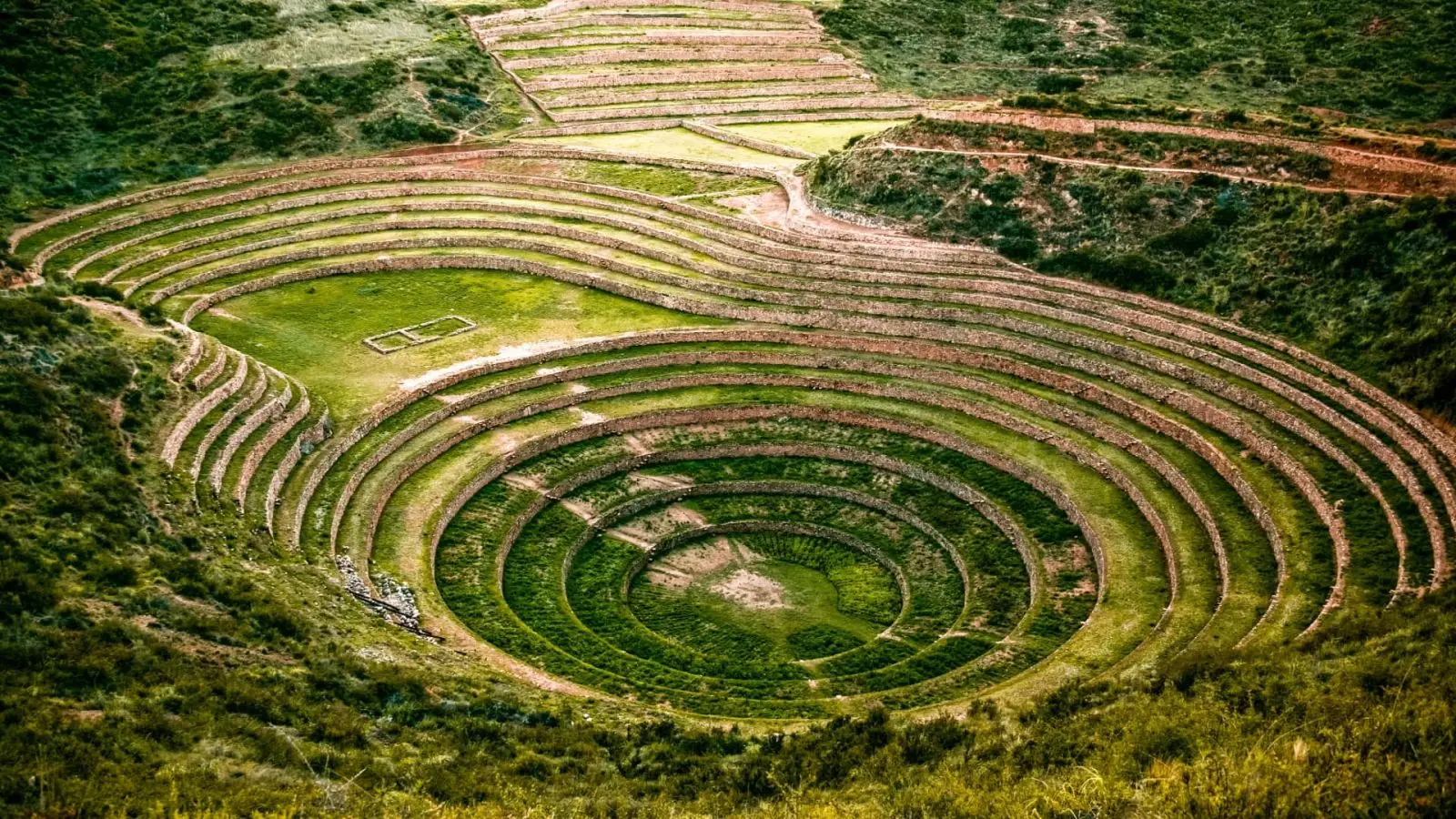
Short answer: Moray is an Inca site of concentric circular terraces built inside natural hollows on the Maras plateau, at about 3,500 m and roughly 50 km from Cusco (1h–1h30 by car via Chinchero and Maras). It is commonly interpreted as an agricultural experimentation site, where each level had its own microclimate. Entry is with the Cusco Tourist Ticket (full ticket or circuit III), you walk marked paths around the rim, and an hour on site is usually enough. The easiest way to go is a private half-day tour that adds the Maras Salt Mines: with Viajes D’MARC it costs US$71 (S/ 250) per vehicle.
What is Moray and why is it circular?
Moray lies a few kilometers beyond the village of Maras, on a high, open plateau between Cusco and the Sacred Valley. The Incas took several natural depressions in the ground and lined them with stone-walled terraces that step down in rings, so each hollow looks like a giant green amphitheater. The largest one, the image on every postcard, is the best preserved and has been partly restored.
Unlike Pisac or Ollantaytambo, Moray has no temples, houses or fortress walls. The terraces themselves are the monument, which is why their purpose has been debated for so long.
The theories
- Agricultural experimentation (the main theory): Moray is commonly interpreted as a place to test and acclimatize crops. Because the rings sink below the plateau, each level gets a different amount of sun and wind, and temperature differences between the top and the bottom are often pointed out. The idea is that the Incas, whose empire spanned coast, highlands and jungle, used these microclimates to adapt plants such as maize to new altitudes.
- A ceremonial space: the circular, theater-like shape has led some researchers to suggest ritual uses, perhaps tied to the farming calendar. Both ideas can be true at once: for the Incas, agriculture and religion went hand in hand.
- Fanciful explanations: you will hear talk of energy fields and other mysteries. There is no evidence for them; the agricultural reading is the one archaeologists support.
The Incas left no written records, so every interpretation comes from archaeology and observation.
What you see at Moray
The main sector
This is the big circular complex by the entrance. From the marked path along its upper edge you look down on the rings stepping toward a flat floor at the bottom. Look out for:
- The retaining walls: stone walls hold up each terrace, and from above the curves are remarkably regular.
- Stone steps set into the walls: stones jutting out of the walls served as stairs between levels, a classic Inca terracing detail.
- The overall shape: part of the complex forms closed rings and part opens into wider, more irregular terraces that follow the natural slope.
- The viewpoints: the path loops high around the rings and gives you several angles; the higher you go, the better you see the full shape.
Access to the lower terraces is restricted to protect the walls: follow the marked paths and respect the ropes and signs. Moray is enjoyed from above, which is also where the best views are.
The smaller sectors
Next to the main complex are other hollows with terraces, smaller and less restored, some partly overgrown. Depending on which paths are open that day, you see them from the trail or from viewpoints. They show that Moray was a larger system, not a single “amphitheater”.
The setting
Around the site stretch the fields of the Maras plateau, with potatoes and grains that change color through the seasons, and on clear days the snowcapped Urubamba range on the horizon. The entrance usually has basic services such as restrooms and a few craft and snack stalls.
How to get to Moray from Cusco
The road runs from Cusco to Chinchero (about 30 km), crosses the plateau and turns off toward Maras village, from where a side road leads to Moray. There is no public transport to the site itself, so these are your options:
| Option | Approx. time | What it includes | Best for |
|---|---|---|---|
| Private Maras & Moray tour (Viajes D’MARC) | Half day, about 5h | Hotel pick-up, Moray and the Salt Mines at your pace, just your group | Couples, families and photographers |
| Shared Maras & Moray tour | 5–6h | Agency bus, fixed schedule, larger group; check whether tickets are included | Solo travelers on a budget |
| Chinchero, Maras, Moray & Ollantaytambo tour | Full day | The whole circuit; can end in Ollantaytambo for the train | Travelers heading to the Sacred Valley or Machu Picchu |
| Colectivo + local taxi | Half day or more | Shared van to the Maras turn-off, then a taxi to Moray | Backpackers with time |
Going on your own, catch a colectivo (shared van) to Urubamba that runs via Chinchero, get off at the Maras turn-off and negotiate with a local taxi; agree on the price, the waiting time at Moray and the return before you get in. Ask your hotel for the current departure point. Each option is covered in detail, Salt Mines included, in our Maras and Moray guide.
Step by step: your visit to Moray
- Buy the Tourist Ticket first. Moray is one of the sites it covers, so get it in Cusco before you leave.
- Start early. Leaving around 8:00 a.m. usually gets you there ahead of the big groups and in softer light.
- Show your ticket at the entrance and begin at the upper viewpoint over the main sector to take in the whole shape.
- Walk the rim path slowly. It has gentle slopes and a few steps; at 3,500 m, take your time.
- Look for the smaller sectors from whichever trails or viewpoints are open.
- Carry on with your day: down to the Salt Mines, on to Urubamba or back to Cusco.
How much time do you need?
Most visitors spend 45 minutes to an hour at Moray; allow an hour and a half if you love photography or are walking slowly because of the altitude. Including the drive, Moray alone takes about 3 to 4 hours from Cusco, and Moray plus the Salt Mines about 5 hours. Add Chinchero and Ollantaytambo and it becomes a full day.
Tickets: Moray and the Cusco Tourist Ticket
- Moray is covered by the Cusco Tourist Ticket (Boleto Turístico): either the full ticket or the partial circuit III ticket, which also includes Pisac, Ollantaytambo and Chinchero.
- The partial ticket is only valid for a short time, so plan the four sites over one or two consecutive days. Our Cusco Tourist Ticket guide explains every option.
- The Maras Salt Mines are not on the ticket; they charge their own fee at the gate.
Combine Moray with the Salt Mines, Chinchero or Urubamba
- Maras Salt Mines: the natural pairing, a short drive across the same plateau. What to expect and when the pans look white is in our Maras and Moray guide; the Maras and Moray tour covers both in half a day.
- Chinchero: right on the way, with its colonial church on Inca walls and its weaving centers. See our Chinchero guide or the Chinchero, Maras, Moray & Ollantaytambo tour.
- Urubamba and the Sacred Valley: from the Maras plateau the road drops to Urubamba, so you can finish at your Valley hotel instead of returning to Cusco. Read our Urubamba guide and see the Cusco to Urubamba taxi or the Cusco to Chinchero taxi.
- Pisac and Ollantaytambo: better on another day, on the Sacred Valley VIP tour.
Altitude, weather and the best time to visit
- Altitude: Moray sits at about 3,500 m, similar to Cusco; the highest point on the way is Chinchero (about 3,760 m). There is little walking, but go slowly, especially in your first days. More advice in our altitude sickness guide.
- Rainy season (December to March): the terraces and fields are at their greenest and Moray looks its best, with dramatic clouds; paths can be slippery and rain tends to come in the afternoon.
- Dry season (May to October): clear skies and ochre and golden tones on the terraces; cold mornings and strong midday sun.
- April and November: shoulder months, often still green and with fewer visitors.
- Time of day: morning and afternoon bring side light that picks out every ring; midday light is flat, and afternoons are windier.
Photo tips and mistakes to avoid
Photo tips:
- Chase side light: the shadow of each ring gives depth; at noon the circles look flat.
- Go wide or shoot a panorama to fit the whole main ring from the upper path; a phone’s 0.5x lens works well.
- Put a person on the rim path for scale: without a reference, the size is hard to read.
- Shoot from several points: the shape changes as you walk around the rings.
- In the rainy season, wait for a break in the clouds: the green after rain is Moray’s best color.
- Drones: they are not allowed at archaeological sites without prior authorization, so don’t count on flying one.
Common mistakes:
- Expecting to walk down into the rings: photos make many people assume so, but access to the lower terraces is restricted.
- Leaving the path or climbing on the walls: you damage a fragile site and could fall.
- Arriving without the Tourist Ticket, or with a partial ticket that has already expired.
- Underestimating sun and wind: bring a hat, sunscreen, water and a light jacket.
- Doing Moray and the Salt Mines on separate days: they are very close, so pair them.
Why trust this guide
It is written by the local drivers of Viajes D’MARC, who have been taking travelers to Moray, Maras and the Sacred Valley every day since 2010. We know when the light is best, how long you really need and how the landscape changes from season to season. Updated November 2026. Third-party prices and hours (Tourist Ticket, colectivos) change, so always confirm them before you go.
Frequently asked questions
What is Moray in Peru?
An Inca site of concentric circular terraces built into natural hollows on the Maras plateau, at about 3,500 m. It is commonly interpreted as an agricultural experimentation site that used the microclimate of each level.
Can you walk down into the Moray terraces?
No. Access to the lower terraces is restricted to protect the walls; you visit along marked paths around the rim, which is also where the best views are.
How far is Moray from Cusco?
About 50 km, 1h to 1h30 by car, via Chinchero and Maras village.
Is Moray included in the Cusco Tourist Ticket?
Yes, on the full ticket and the partial circuit III ticket, which also covers Pisac, Ollantaytambo and Chinchero. The Maras Salt Mines are paid separately.
How much time do you need at Moray?
Between 45 minutes and an hour on site, up to an hour and a half if you take lots of photos. From Cusco, combined with the Salt Mines, it is a half-day trip.
How much is a private tour to Moray?
With Viajes D’MARC, the private Maras and Moray tour costs US$71 (S/ 250) per vehicle, not per person, with hotel pick-up. The price is confirmed before you set off.
Is Moray worth visiting?
Yes, if you are interested in Inca engineering and Andean landscapes. It is a short, easy visit that is far more rewarding combined with the Maras Salt Mines or Chinchero.