
Short answer: Pisac is a Sacred Valley town at about 2,950 m, roughly 33 km and 1 hour from Cusco. It is famous for its Inca archaeological park, with terraces and temples on the mountain above town, and for its craft market, open every day. The ruins are covered by the Cusco Tourist Ticket (full ticket or circuit III). Allow half a day for ruins and market; with Viajes D’MARC a private tour costs from US$60 (S/ 210) per vehicle.
What and where is Pisac?
Pisac sits on the Vilcanota River, right where the road from Cusco drops into the Sacred Valley, which is why it is called the gateway to the valley. It is about 33 km via Tambomachay and the Taray viewpoint, approx. 50 minutes to 1 hour by car. Its relaxed feel draws travelers who stay for several days, many of them on yoga and wellness retreats.
When planning, think of its three parts separately: the town (about 2,950 m), the market on the square and the archaeological park on the mountain above, whose upper part reaches about 3,350 m.
Pisac ruins: what to see
This is one of the largest Inca complexes in the Sacred Valley: a series of sectors spread over the ridge and slopes, linked by stone paths and staircases.
The terraces
The classic image of Pisac: huge agricultural terraces that follow the curve of the hillside. The Incas built them to farm steep ground, use different microclimates and hold back erosion.
Residential and ceremonial sectors
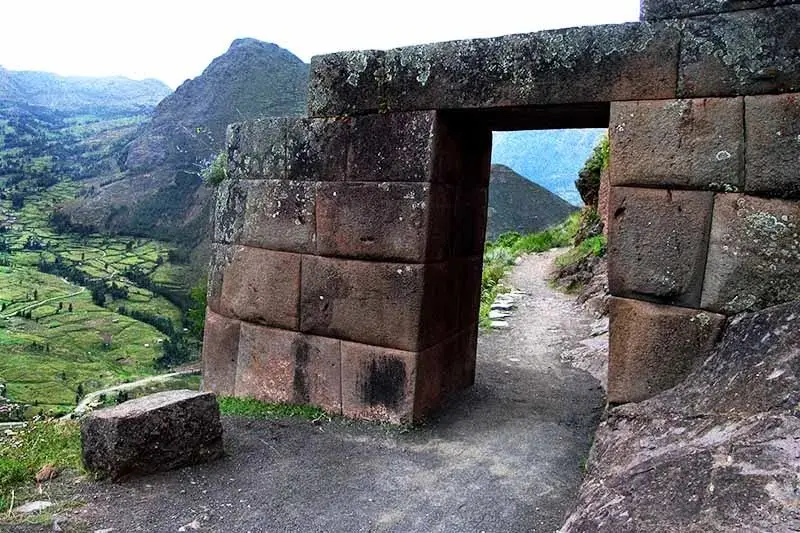
Near the upper entrance is Q’allaqasa, a cluster of buildings perched above the valley. Follow the trail, which passes through a short rock tunnel at one point, and you reach the Intihuatana area, the ceremonial sector, with finely fitted stonework in the same style as the best temples in Cusco.
The Inca cemetery
Across the neighboring ravine, the cliff face is dotted with small openings: these were tombs, looted centuries ago. It is considered one of the largest known Inca cemeteries and is seen from the trails.
How to get up to the ruins: drive or hike
There are two entrances. The upper entrance is next to a parking area reached by a winding road from town (approx. 20 to 30 minutes by car). The lower entrance is in town: from there an Inca trail climbs between the terraces, steep and with lots of stone steps.
| Option | Approx. time | Effort | Best for |
|---|---|---|---|
| Drive to the upper entrance and back | 20–30 min drive + 1.5–2 h visit | Easy to moderate | Families, older travelers, tight schedules |
| Drive up, hike down to town | 1.5–2 h visit + approx. 1.5 h descent | Moderate; hard on the knees | Most people: you see everything and finish at the market |
| Hike up from town | Approx. 1.5–2 h climb, plus the visit | Hard: steep and sunny | Acclimatized hikers who start early |
Without your own transport, there are usually taxis in town that drive up to the upper entrance; agree on the fare and any waiting time first. Both entrances have a checkpoint where you show your Tourist Ticket.
Pisac market
The market fills the main square and surrounding streets and runs every day. Sundays are usually the busiest, with more stalls and more people from nearby communities, who also buy and sell farm produce. Weekdays are quieter.
- What you will find: alpaca and wool textiles, blankets, ceramics, silver jewelry, musical instruments, carved stones and souvenirs.
- Quality: handmade pieces sit next to factory-made goods; if you want something special, ask who made it and how.
- Food: bakeries with clay ovens sell empanadas and fresh bread, and there are cafés and restaurants around the square.
Tickets and how much time you need
There is no single-site ticket for the Pisac ruins: you enter with the Cusco Tourist Ticket (Boleto Turístico), either the full ticket (all sites, valid for several days) or the partial circuit III ticket, which covers Pisac, Ollantaytambo, Chinchero and Moray and is valid for a shorter period. It is sold at the COSITUC offices in Cusco and, in general, at the sites themselves. Prices, validity and park opening hours change, so check them before you go. Our Cusco Tourist Ticket guide explains it all. The town and market are free.
| Plan | Time in Pisac | What it covers |
|---|---|---|
| Market only | 1–1.5 h | The square, shopping and empanadas |
| Ruins from the upper entrance | 1.5–2 h | Terraces, Q’allaqasa and Intihuatana without rushing |
| Ruins + hike down + market | 3.5–4 h | The most complete day visit |
| Half day from Cusco | Approx. 5 h in total | Ruins, market and about 50 min of driving each way |
| One or more nights | 1–3 days | Ruins at opening time, the Sunday market and rest at lower altitude |
Best time of day, weather and altitude
Best time of day
The ruins are best first thing in the morning: fewer people and the sun not yet beating down on the terraces, which have almost no shade. Shared Sacred Valley tours tend to arrive mid-morning. The market, on the other hand, gets going from mid-morning, so the logical order is ruins first, market second.
Time of year
May to September (the dry season) brings clear skies, cold mornings and dry trails. From December to March it rains often, mostly in the afternoon: the valley is lush and quieter, but the stone steps get slippery.
Altitude: an advantage
The town is about 450 m lower than Cusco (approx. 3,400 m), so it is a good place for your first days. Keep in mind that the top of the ruins is at a similar height to Cusco, and hiking up from town is hard work if you have just arrived. If you have symptoms, read our guide to altitude sickness in Cusco.
Step by step: half a day in Pisac from Cusco
- 7:00 am – Leave Cusco. The road passes Q’enqo, Puka Pukara and Tambomachay; short stop at the Taray viewpoint.
- 8:15 am – Upper entrance. Show your ticket at the checkpoint and start with Q’allaqasa.
- Intihuatana and viewpoints. The ceremonial sector, with views of the tombs in the ravine.
- Choose how to go down. Back to the vehicle, or hike down the terraces while your driver waits in town.
- 10:30–11:30 am – Market and empanadas, depending on how you came down.
- 12:30 pm – Back to Cusco (around 1:30 pm), or continue to Urubamba and Ollantaytambo if you are staying in the valley.
Getting there and combining Pisac with the Sacred Valley
From Cusco or the airport
- Colectivo or local bus: the cheapest option, with frequent daytime departures (check the current stop, as it changes); it drops you in town, far below the upper entrance.
- Private taxi: our private Cusco to Pisac transfer drops you in town, at your lodging or at the park entrance, from US$34 (S/ 120) per vehicle. Flying in? The Cusco airport to Pisac transfer goes straight to the valley.
- Private tour: the private Pisac tour includes your driver waiting during the visits.
With the rest of the valley
Pisac is the first stop on the classic route. Downriver are Calca, Urubamba (approx. 40 km, about 50 minutes) and Ollantaytambo (approx. 60 km, around 1 h 15), with its fortress and the train station for Machu Picchu. Up on the plateau above the valley are Chinchero and Maras and Moray.
- In one day: the Sacred Valley VIP tour combines Pisac, Ollantaytambo and Chinchero.
- Over two days: Pisac as a half day and, on another day, the Chinchero, Maras, Moray and Ollantaytambo tour. To prepare, read our Maras and Moray guide and what to see in Ollantaytambo.
Where to stay
Staying in town near the square puts you within walking distance of the market, restaurants and the lower entrance to the ruins. On the outskirts, by the river or along dirt roads, there are guesthouses, eco-lodges and retreat centers that are quieter, but you will need a mototaxi or vehicle to get around. For a more central base, see our Urubamba guide.
Tips and mistakes to avoid
- Carry cash in soles, in small notes. Many stalls do not take cards and there are few ATMs in town.
- Bargain politely. Asking for a better price is normal, especially if you buy several items, but do not push it too far.
- Protect yourself from the sun. Sunscreen, a hat and water: at this altitude the sun burns even when the air is cool.
- Wear shoes with good grip. There are high steps, narrow paths beside drops and slippery stone after rain.
- Do not forget your ticket. You cannot get in without it; if you buy circuit III, make sure its validity covers the other valley sites.
- If Pisac is a priority, skip the shared tour: it usually gives Pisac little time, sometimes only the market or only the ruins.
Why trust this guide
It is written by the local drivers of Viajes D’MARC, who have been taking travelers to Pisac and the Sacred Valley every day since 2010: we know the road to the upper entrance, how long visits really take and the quietest times of day. Updated November 2026. Third-party fees and schedules (Tourist Ticket, colectivos, park hours) change, so always confirm them before you go.
Frequently asked questions
How long does it take to get from Cusco to Pisac?
Approx. 50 minutes to 1 hour by car for about 33 km, on the road past Tambomachay and down via the Taray viewpoint.
How do I get from Cusco to Pisac and back?
By colectivo (shared van), which leaves central Cusco when full and drops you in Pisac town in about an hour, then the same way back; or by private taxi, which can wait while you visit and take you up to the upper entrance of the ruins. A private taxi from Cusco to Pisac costs from US$34 (S/ 120) per vehicle.
Can I visit Pisac on my own?
Yes. Take a colectivo to town, then hike up to the ruins (approx. 1.5 to 2 hours, steep) or take a local taxi to the upper entrance, agreeing on the fare first. If you are short on time, a private transfer or tour is more practical.
How much is the entrance to the Pisac ruins?
There is no single-site ticket: you need the full Cusco Tourist Ticket or the partial circuit III ticket, which covers Pisac, Ollantaytambo, Chinchero and Moray. Prices are set by COSITUC and change, so check them before you go. The market is free.
What is the best day for the Pisac market?
It is open every day. Sundays are usually the busiest, with more stalls and people from local communities; weekdays are calmer if you want to shop without crowds.
Is it worth staying overnight in Pisac?
Yes, if you want a slower pace, the ruins at opening time and an easier start at lower altitude than Cusco. If your priority is an early train to Machu Picchu, Ollantaytambo, where the train leaves from, works better.
Do I need a guide for the Pisac ruins?
It is not compulsory, but there is little signage explaining the sectors. Local guides usually wait at the entrance, and if you travel with Viajes D’MARC we can help you arrange one on WhatsApp.