
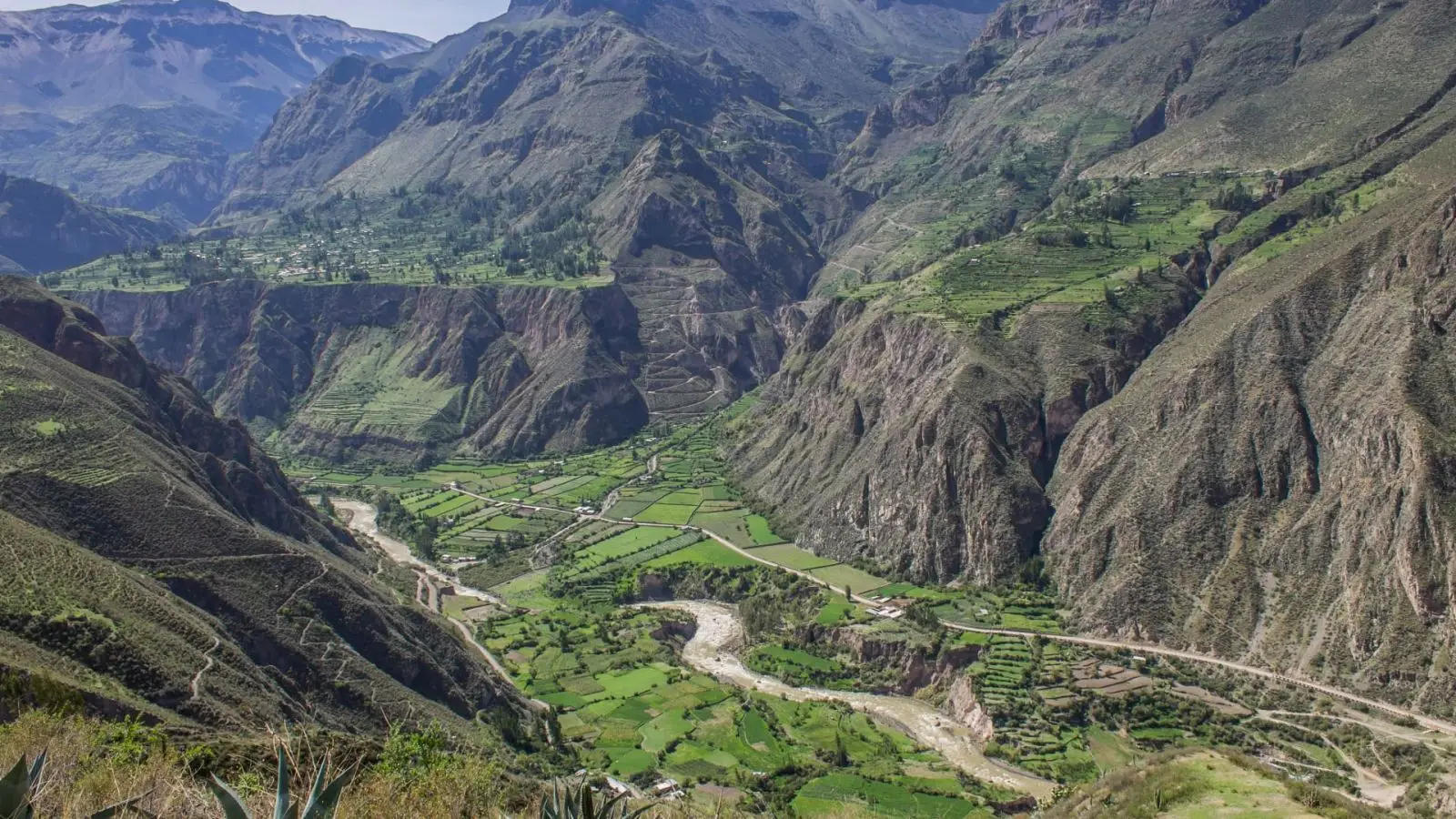
Short answer: Colca Canyon lies in Caylloma province, Arequipa region, about 160 km by road from the city of Arequipa. A paved road takes you to Chivay in approx. 3.5 hours, over a pass at almost 4,900 m (16,000 ft), and from there you follow the valley for another 40 to 50 km to the Cruz del Condor viewpoint, where condors usually fly between 8 and 10 a.m. You can do it as a Colca Canyon day trip from Arequipa (about 14 hours) or over two days sleeping in the valley; with Viajes D’MARC a private day tour costs from US$180 (S/ 630) per vehicle, with hotel pick-up.
What Colca Canyon is
Colca is the canyon carved by the Colca River between volcanoes, north of Arequipa city. The most widely quoted figure puts its deepest point at about 3,270 m (some sources say 3,400 m, depending on how it is measured), almost twice the depth of the Grand Canyon; even so, neighboring Cotahuasi Canyon, also in Arequipa, is said to be slightly deeper. At Cruz del Condor the canyon floor lies about 1,200 m below the viewpoint. The valley is part of the Colca and Volcanoes of Andagua UNESCO Global Geopark.
Its pre-Inca terraces, built by the Collagua and Cabana peoples, are still farmed today, and the Wititi dance of the Colca Valley was inscribed by UNESCO on the Intangible Cultural Heritage list in 2015.
How to get to Colca Canyon from Arequipa
The route leaves Arequipa (approx. 2,300 m / 7,550 ft) via Yura and climbs between Misti and Chachani volcanoes onto the high puna. It is about 160 km to Chivay, the capital of Caylloma province and gateway to the valley, in approx. 3.5 hours without long stops; almost all of it is paved, with plenty of bends. From Chivay the road follows the rim of the canyon through Yanque, Achoma, Maca and Pinchollo to Cruz del Condor, about 40 to 50 km on (approx. 1 to 1.5 hours).
What you see on the way
- Salinas and Aguada Blanca National Reserve: a protected area created in 1979 and managed by SERNANP, mainly to protect the vicuña. On the Cañahuas plain you will usually see wild vicuñas close to the road.
- Mirador de los Andes or Volcanoes Viewpoint (Patapampa): the highest point, at almost 4,900 m, with stone cairns and, on clear days, volcanoes such as Ampato, Sabancaya (which often puffs out steam and ash) and Chachani.
Altitude and acclimatization
The challenge is not walking but altitude: in two to three hours you climb from about 2,300 m to almost 4,900 m, then drop to Chivay (approx. 3,600 m / 11,800 ft); headaches or shortness of breath at the pass are common. If you arrive from Lima or the coast, spend one or two days in Arequipa first; if you come from Cusco or Puno, you will already be acclimatized. Eat a light breakfast, drink water and check with your doctor if you have heart or lung conditions or are pregnant. More advice in our altitude sickness guide.
Day trip, two days or private car: which to choose
| Option | Duration | Pros | Cons | Best for |
|---|---|---|---|---|
| Shared day tour | About 14 h, pre-dawn start | Per-person price, everything organized | Hotel-by-hotel pick-up, fixed schedule, everyone reaches the viewpoint at once | Solo travelers short on time |
| Private day tour | About 14 h, you choose the time | Just your group, stops wherever you like, more time at Cruz del Condor if the condors are late | Price is per vehicle; a long day in the car | Couples, families and groups with one day |
| 2 days / 1 night | Night in Chivay or the valley | Less tiring, time for hot springs and villages, Cruz del Condor early the next morning | Needs an extra day and lodging | Travelers who want to enjoy the valley |
| Public bus | 2 days or more | Cheapest | Changes, hard to reach Cruz del Condor at condor time | Backpackers in no hurry |
There are two private options: the private Colca Canyon day tour, with a driver who waits at every stop, or the private Arequipa to Chivay transfer to sleep in the valley and book your return for whichever day you like. To have everything arranged, there is the Arequipa and Colca Canyon package.
Cruz del Condor: when you can see the condors
Cruz del Condor (Cruz del Cóndor) is Colca’s most famous viewpoint, between Pinchollo and Cabanaconde, with several platforms linked by short paths. Condors spend the night on the canyon walls and, once the sun warms the air, ride the thermals upward. That is why your best chances are usually roughly between 8 and 10 a.m.
- No guarantees: they are wild birds. Some days you see many condors and some days none, especially with cloud or rain.
- Season: in the dry season, roughly April to November, skies are usually clear and the odds are better.
- Patience: stay at least an hour. On a private tour you can wait longer if they have not shown up yet.
The Colca tourist ticket and other costs
To travel through the valley you need the Boleto Turístico del Colca, the Colca tourist ticket, sold by the Autoridad Autónoma del Colca (AUTOCOLCA) at the checkpoint at the entrance to the valley. It is separate from the Cusco Tourist Ticket; rates differ for foreigners, Latin Americans and Peruvians and change over time, so confirm the current price before you travel and bring cash in soles.
Also paid separately: meals in Chivay, La Calera hot springs (a few kilometers from town) and tips for photos with alpacas or birds of prey. None of this is included in the Viajes D’MARC tour or transfer.
Best time, weather and what to pack
- April to November (dry season): clear skies, the best volcano views and usually the best conditions for condors. Pre-dawn hours are very cold and it can freeze at the pass.
- December to March (rainy season): the valley is greener, but there is more cloud in the canyon, afternoon rain and sometimes snow at Patapampa. It is doable if you stay flexible.
In any month the midday sun is fierce and the wind at the pass is icy. Pack layers (a warm jacket, hat and gloves), sunscreen and sunglasses, water, snacks, motion-sickness tablets if winding roads bother you, a swimsuit for La Calera, your passport and cash in soles in small notes: outside Chivay there are hardly any ATMs. For more ideas, see our packing list for Cusco and the Andes and our guide to the best time to visit.
Step by step: a Colca Canyon day trip from Arequipa
- Pre-dawn pick-up (around 3 a.m.). The first stretch is in the dark, so sleep if you can.
- Vicuñas and Patapampa. A short stop on the Cañahuas plain and volcano photos; move slowly, you are at almost 4,900 m.
- Ticket and breakfast. Buy the ticket at the entry checkpoint and have breakfast in Chivay.
- Valley villages. You pass Yanque, Achoma, Maca and Pinchollo; in Yanque’s square you can often see the Wititi dance in the morning.
- Cruz del Condor (approx. 8:30 to 10 a.m.). An hour or more at the viewpoints.
- Back through the valley. Stops at terrace viewpoints, lunch in Chivay and, if you like, a soak at La Calera hot springs.
- Return to Arequipa over the same pass, arriving mid to late afternoon. It is about 400 km in total.
From Colca to Puno: continuing your trip
To continue to Lake Titicaca, there are two ways:
- Return to Arequipa and leave the next day: the simplest option. The private Arequipa to Puno transfer covers about 295 km in approx. 5 hours across the high plateau, with lagoons and vicuñas.
- Go straight from Chivay: the road climbs back over Patapampa, crosses the Salinas and Aguada Blanca reserve, joins the Arequipa–Puno highway and continues across the plateau, above 4,400 m, to Juliaca and Puno. It is approx. 240 to 260 km and about 5 to 6 hours of driving. Privately, we arrange it as a tailor-made trip: just ask on WhatsApp.
Prepare the next leg with our Lake Titicaca and Uros guide and, if Cusco comes next, our Cusco to Puno guide. Flying into Arequipa? Book the Arequipa airport to hotel transfer.
Tips and mistakes to avoid
- Doing the day trip the day after arriving from the coast: climbing to almost 4,900 m without acclimatizing is the most common cause of a bad day. The day before, take the gentler Arequipa city and countryside tour.
- Leaving Arequipa late: if you reach Cruz del Condor at noon, the condors have usually moved on.
- Trying to reach Puno on the same day as the Colca day trip: they are two long journeys; sleep in the valley or in Arequipa in between.
- Booking informal transport: on winding mountain roads with frost, who drives matters.
Why trust this guide
It is written by the local drivers of Viajes D’MARC, who have driven the roads of southern Peru since 2010, including the routes from Arequipa to Colca and to Puno. We know the real travel times, the stops worth making and how the altitude feels at the pass. Updated November 2026. Third-party tickets, schedules and conditions change: confirm them before you go.
Frequently asked questions
How long is the drive from Arequipa to Colca Canyon?
About 160 km and approx. 3.5 hours to Chivay, the gateway to the valley. Cruz del Condor is approx. 1 to 1.5 hours further; with stops, allow about 5 hours.
Can you visit Colca Canyon in one day?
Yes. A Colca Canyon day trip leaves before dawn, covers about 400 km and lasts about 14 hours. You see the highlights but spend a lot of time in the vehicle; with two days you rest better and can visit the hot springs.
What time do condors fly at Cruz del Condor?
Usually between 8 and 10 a.m., as the air warms up. It is not guaranteed, because they are wild birds, and your odds are better in the dry season.
How much is the Colca Canyon entrance fee?
You pay for the Colca tourist ticket, sold by the Autoridad Autónoma del Colca at the entry checkpoint. The rate depends on your nationality and changes, so confirm it before you travel and bring cash.
Can I go from Colca straight to Puno?
Yes, by road from Chivay across the high plateau, in about 5 to 6 hours. You can also return to Arequipa and take the Arequipa to Puno transfer the next day. Ask us on WhatsApp for a tailor-made route.
How much is a private Colca Canyon tour from Arequipa?
With Viajes D’MARC, from US$180 (S/ 630) per vehicle, not per person, with hotel pick-up and drop-off and a driver who waits. The tourist ticket, meals, hot springs and a guide are paid separately.