
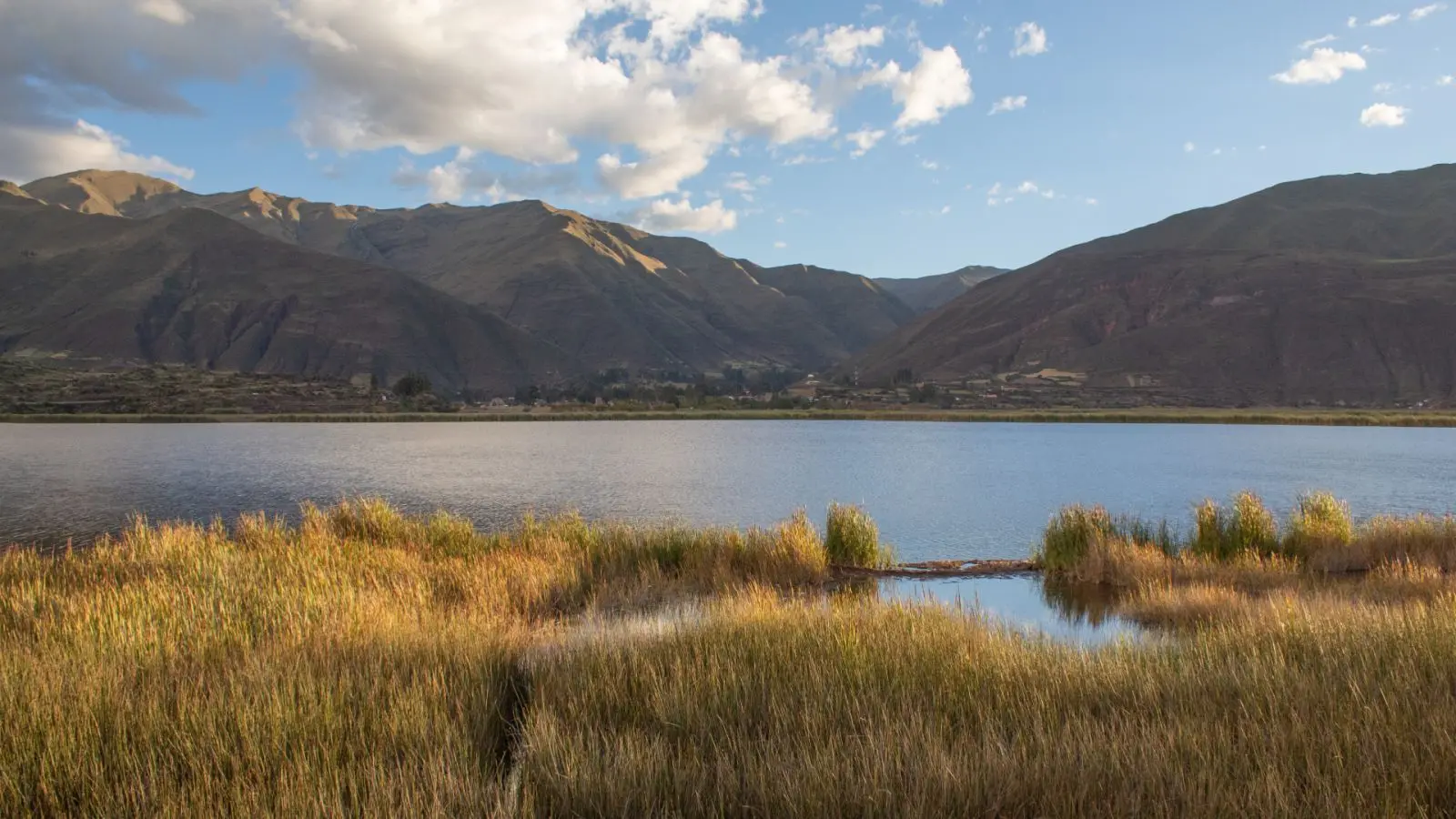
Short answer: Lake Titicaca is shared by Peru and Bolivia, sits at about 3,800 m and is often described as the highest navigable lake in the world. On the Peruvian side you visit it from Puno: local operators run boats from the port to the Uros floating islands (half day), to Uros and Taquile (full day) or with a night at a family homestay on Amantaní (2 days). Plan on 2–3 nights in Puno. Viajes D’MARC does not run boats: we drive you to Puno by road from Cusco, from US$229 (S/ 800) per vehicle, from Arequipa or from Juliaca airport.
Lake Titicaca at a glance: where it is and what makes it special
- Location: on the Andean high plateau (altiplano), straddling the border between Peru (Puno region) and Bolivia (La Paz department).
- Altitude: the surface sits at about 3,800 m, higher than Cusco (about 3,400 m). Puno, the base town on the Peruvian side, is at about 3,830 m.
- Size: more than 8,000 km² and about 190 km long. From the shore it looks like a sea.
- Nature: the reed beds of Puno Bay are part of the Titicaca National Reserve.
- Culture: Quechua and Aymara communities live on its shores and islands; many consider it sacred, and it features in the legends of the Incas’ origins.
To compare buses, the train and a private car to Puno, read our Cusco to Puno guide.
The Uros floating islands: what the visit is like
The Uros are man-made islands built from layers of totora, a reed that grows in the lake. Families cut the reeds, pile them on top of floating blocks of root mass, anchor the island to the lake bed and add fresh layers regularly, because the bottom ones rot in the water. The islands are inside the bay, about 20–30 minutes by boat from Puno’s port.
The visit is short: about 2–3 hours from the port, with 45–60 minutes on one island. It usually goes like this:
- A community member uses a small model to explain how an island is built and anchored.
- You step inside a reed house and browse embroidery and crafts for sale.
- Optionally, a ride on a traditional reed boat to a neighbouring island, paid separately on the spot.
The communities organise the visits themselves and take turns hosting groups, so you don’t choose the island. It is very touristy, but the technique is genuine and tourism is now one of these families’ main sources of income.
Taquile and Amantaní: the natural islands
Taquile
Taquile is a natural island of earth and rock about 35 km from Puno, 2–3 hours by boat depending on the vessel. It has farming terraces, stone walls and views that reach Bolivia’s snowy peaks on clear days. Its Quechua community runs tourism collectively.
The island is known for its textile tradition, recognised by UNESCO as intangible cultural heritage. Men knit their chullos (woolly hats) and women weave belts and other garments on looms; the colour and style of a man’s chullo show his marital status.
Be ready to walk: from the dock to the square is a 30–45 minute climb on paths and stone steps, which feels hard at this altitude. Lunch is usually at a family home, often quinoa soup and lake trout.
Amantaní
Bigger, farther out (about 3 hours by boat) and much quieter. Visitors sleep in family homes, with guests shared out between households in turns. You share a simple dinner with your hosts and climb at sunset to one of the two hilltop ceremonial sites, Pachamama and Pachatata. Rooms are basic and nights are very cold, so bring a headlamp and warm layers.
Which Lake Titicaca tour should you choose?
All tours leave from Puno’s port and are run by local agencies and boat operators. Viajes D’MARC does not run boats or lake tours: our job is getting you to Puno by road.
| Option | Approx. length | What you see | Best for |
|---|---|---|---|
| Half-day Uros | 2–3h | One Uros island, plus the reed-boat ride if you want it | Short on time, or your arrival day |
| Full-day Uros + Taquile | 8–10h | Uros, the walk and lunch on Taquile | Most travelers |
| Fast boat Uros + Taquile | 6–8h | The same, with less time on the water | Anyone who wants to be back earlier |
| 2 days with Amantaní | 2 days, 1 night | Uros, a homestay night on Amantaní, Taquile the next day | Travelers after a real exchange who can live with basic comforts |
Before paying, ask about the hotel pick-up time, whether a guide is included and in which language, whether lunch is included and whether the island entry fees are extra (they are usually paid on site). Prices and departure times vary by operator and season, so confirm them directly.
Step by step: planning your Lake Titicaca visit
- Get to Puno with a day to spare. From Cusco, take our private Cusco ⇄ Puno transfer with stops on the Route of the Sun; from Arequipa, the Arequipa ⇄ Puno transfer (about 5 hours across the plateau); and if you fly in, the Juliaca airport ⇄ Puno transfer (about 1 hour). Rest on your first afternoon.
- Book your tour. For the full day or Amantaní, book at least a day ahead; earlier in high season and during Candelaria.
- Start early. Full-day tours pick up from hotels very early, often before 7 a.m., and the lake is usually calmer in the morning.
- Plan your departure. Move on the day after your tour, not the same afternoon.
On dry land: Sillustani, Chucuito and the Bolivian side
Sillustani
About 35 km from Puno (roughly 45 minutes by road), beside Lake Umayo, stand the chullpas: stone funerary towers built by the Colla, the people who ruled the plateau before the Incas, and later by the Incas too. The tallest are about 12 m high. Allow 2–3 hours on a local tour or by taxi; late-afternoon light is the most beautiful.
Chucuito
About 18 km south of Puno on the lakeshore, this village has colonial churches and the Inca Uyo enclosure, with carved stones linked to fertility rites.
The Bolivian side: Copacabana and Isla del Sol
Copacabana is about 3 hours from Puno across the border, and boats leave from there to Isla del Sol. It means going through immigration, so check Bolivia’s entry requirements for your nationality and make sure there are no blockades at the border before you plan it.
How many days do you need at Lake Titicaca?
- Half a day: the Uros only; Taquile doesn’t fit into a morning.
- 2 nights in Puno: arrive, do the full-day Uros + Taquile tour and leave the next morning. This is the minimum we recommend.
- 3 nights: add Sillustani and Chucuito, or swap the full-day tour for the 2-day Amantaní homestay.
To combine the lake with Arequipa, the Colca Canyon and Cusco without handling the logistics yourself, our Arequipa to Cusco road trip (7 days) and Southern Peru Grand Road Trip (11 days) include the Uros and Taquile boat tour with a local operator.
Flying into or out of Juliaca? Leave at least one night between your lake day and the flight: full-day tours return mid-afternoon and the airport is an hour from Puno.
Altitude, cold and the best time to visit
Puno and the islands are higher than Cusco, and on Taquile and Amantaní you climb higher still on foot. Ideally, arrive after two or three days in Cusco or the Sacred Valley, eat light and walk slowly; more in our altitude sickness guide.
- Dry season (May to October): the best time, with blue skies and a sparkling lake. The daytime sun burns; nights drop below freezing, especially in June and July.
- Rainy season (December to March): green scenery and afternoon storms that can make the lake choppy; morning departures are usually calmer.
- February, Candelaria: the Virgen de la Candelaria festival fills Puno with dancers and brass bands for days. It is spectacular, but hotels and transport sell out.
To fit the lake into the rest of your trip, see our guide to the best time to visit Cusco.
Tips and mistakes to avoid
- Going without cash: there are no ATMs on the islands; community fees, the reed-boat ride, food and crafts are paid in soles, ideally small notes.
- Dressing only for the sun: bring layers, a windbreaker, a hat and gloves; it is cold on the boat’s top deck.
- Skipping sunscreen: with this altitude and the glare off the water you burn in minutes, lips and ears included.
- Buying a tour from street touts or at the bus station: book through your hotel or a registered agency and get what’s included in writing.
- Taking photos without asking: ask first, especially with children and elders; buying a craft is a good way to say thanks.
- Unmarked taxis: to the port or Sillustani, use an identified taxi; our safe taxi tips apply in Puno too.
Why trust this guide
It is written by the local drivers of Viajes D’MARC, who have been taking travelers along southern Peru’s routes every day since 2010, including Cusco–Puno, Arequipa–Puno and Juliaca airport. Updated November 2026. Boat-tour prices, departure times and island fees are set by the operators and communities, so always confirm them before you pay.
Frequently asked questions
How do I get to the Uros floating islands?
By boat from Puno’s port, about 20–30 minutes away. Local agencies and operators sell the trip on its own as a half day or combined with Taquile as a full day.
Are the Uros islands worth visiting?
Yes, as long as you know it is a short, very touristy visit. Seeing how a floating reed island is built is unique, and the communities rely heavily on this tourism.
Taquile or Amantaní: which is better?
Taquile is a day trip known for its textiles and views. Amantaní means sleeping at a local family’s home: quieter and more personal, but with basic comforts and very cold nights.
Does Viajes D’MARC run Lake Titicaca boat tours?
No, the boats are run by local companies from Puno’s port. We provide private road transport: Cusco ⇄ Puno from US$229 (S/ 800) per vehicle, Arequipa ⇄ Puno and Juliaca airport ⇄ Puno. Our southern Peru packages include the boat tour.
Can I visit the Bolivian side from Puno?
Yes. Copacabana is about 3 hours away across the border, and boats leave from there to Isla del Sol. Check Bolivia’s entry requirements for your nationality first.
When is the best time to visit Lake Titicaca?
May to October, the dry season, with clear skies and very cold nights. Candelaria takes place in February: it is a huge festival, but you need to book well ahead.