
Short answer: Urubamba is the largest town in Peru’s Sacred Valley, at about 2,870 m (roughly 500 m lower than Cusco) and 57 km from Cusco, about 1h15–1h30 by road via Chinchero. Many travellers base themselves here because it sits in the middle of the valley, an hour or less from Maras, Moray, Chinchero, Pisac and the Ollantaytambo train station. You can get there by colectivo from central Cusco or by private taxi, from US$43 (S/ 150) per vehicle with Viajes D’MARC.
Where Urubamba is and why so many travellers stay there
Urubamba, capital of the province of the same name, lies on the floor of the Sacred Valley on the banks of the Vilcanota–Urubamba River, between Calca and Ollantaytambo. Behind it rise the glaciers of the Urubamba range, with Mount Chicón as the backdrop. One thing to watch: “Urubamba” is the town, the river and the mountain range, so check which one a map or review means.
- Lower altitude: sleeping at 2,870 m instead of 3,400 m makes your first nights in the region easier.
- Central location: Maras, Moray, Chinchero, Pisac and Ollantaytambo are all under an hour’s drive.
- Close to the Machu Picchu train: Ollantaytambo station is about 20 km away, roughly 25–30 minutes.
- Milder weather: days are usually warmer than in Cusco.
- A real working town: a market, banks and ATMs, pharmacies and local transport.
If you only have a day or two and want museums and nightlife, stay in Cusco and see the valley on a day tour.
How to get to Urubamba from Cusco and Cusco airport
- Via Chinchero (fastest): about 57 km, 1h15–1h30. The road climbs to the Chinchero plateau (about 3,760 m, the highest point of the trip), then winds down into the valley. Almost every colectivo and transfer uses it.
- Via Pisac and Calca: about 75 km, 1h45–2h without stops. It follows the valley floor, which makes sense if you want to stop in Pisac.
- From Cusco airport: there is no direct public transport. A private Cusco airport to Sacred Valley transfer takes about 1h20–1h30 depending on traffic, from US$57 (S/ 200) per vehicle; the alternative is a Cusco airport taxi to the colectivo stop and then the colectivo, two legs with your luggage.
- By colectivo: shared cars and vans leave central Cusco (the Calle Pavitos area is the best known) when full, take about 1h30 and drop you at the Urubamba terminal on the main road, where you hop in a mototaxi. The stop can move, so check with your hotel and agree the fare before getting in.
| Option | Approx. time | Pros | Cons | Best for |
|---|---|---|---|---|
| Colectivo or van | 1h30 + mototaxi | Cheapest | Leaves when full, little luggage space | Backpackers travelling light |
| Sacred Valley tour ending in Urubamba | Full day | Sightseeing and transport in one | Luggage in tow, group schedule | Travellers in no hurry |
| Private Cusco ⇄ Urubamba taxi | 1h15–1h30 | Door to door, just your group, fixed price per vehicle | Pricier if you travel solo | Families, couples, groups and arrivals by plane |
Step by step: from Cusco airport to your Urubamba hotel
- Book on WhatsApp with your flight number, hotel, number of travellers and bags. We confirm the fixed vehicle price before the trip.
- Send your exact location: many countryside lodges sit on unsigned dirt lanes.
- Walk out of arrivals and your driver is waiting with a name sign and helps with your bags.
- Via Chinchero, with an optional stop at a viewpoint on the way down, facing the valley and the peaks.
- Arrive at your hotel in about 1h20–1h30. Spend that afternoon resting, drinking water and eating light.
Things to do in Urubamba
In town
- The Plaza de Armas and its colonial church, ringed by mountains.
- The market: people from nearby communities sell potatoes, corn, fruit and herbs. It’s a food market, not a souvenir market; go in the morning and ask before photographing people.
- Local food: choclo con queso (corn on the cob with fresh cheese; the valley’s giant white corn is famous), trout and simple set lunches. Houses with a small red flag on a pole sell chicha, the traditional corn beer.
- Ceramics and craft workshops in and around town.
The river and the valley landscape
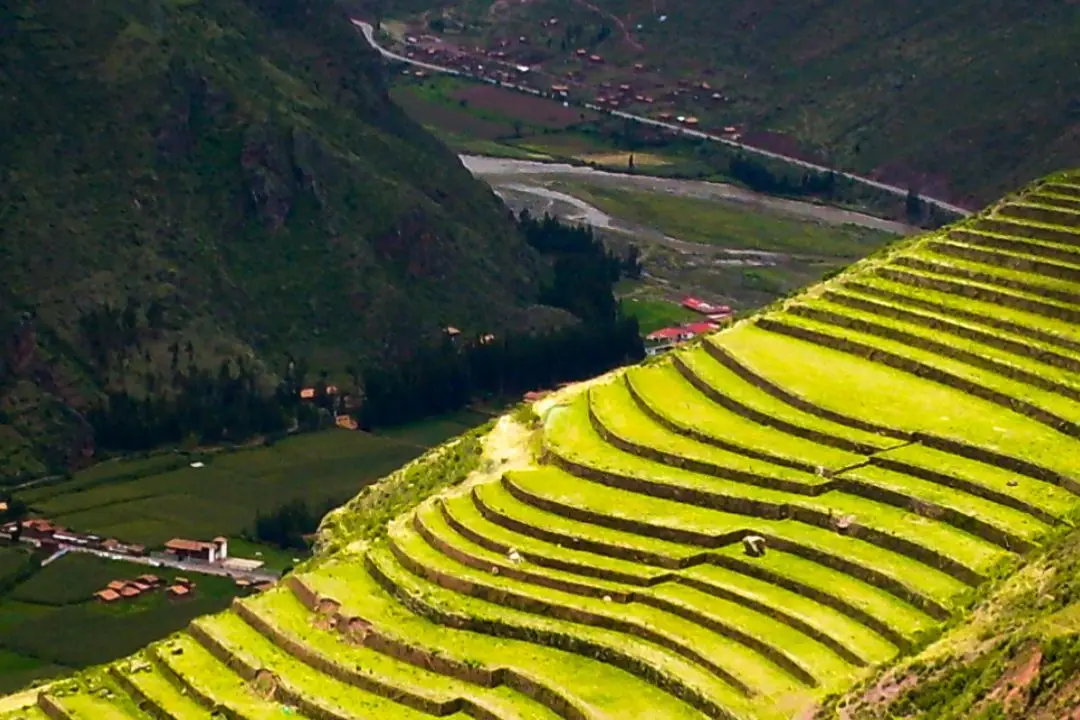
The Urubamba River runs between cornfields, eucalyptus groves and Inca terraces, like those in neighbouring Yucay, about 3 km away. In the dry season it flows calm and greenish; in the rainy season it swells, turns brown and runs fast, so it’s not for swimming. There are easy walks along farm tracks and the riverbank, and the Pumahuanca valley climbs behind town toward the mountains. Local agencies offer horse riding, mountain biking and, in the dry season, gentle rafting on some stretches; ask about the grade and safety gear.
Day trips from Urubamba
| Destination | Approx. drive | Highlights |
|---|---|---|
| Maras Salt Mines | 30–40 min | Thousands of salt pans on a hillside |
| Moray | 40–50 min | Circular Inca terraces |
| Chinchero | 30–40 min | Weavers, colonial church and terraces |
| Ollantaytambo | 25–30 min | Fortress, Inca town and train station |
| Pisac | 45 min–1h | Hilltop ruins and craft market |
| Lares | 2h or more | Hot springs and weaving communities |
- Maras and Moray: the closest sights, in half a day. Read our Maras and Moray guide or book the Maras & Moray tour.
- Full day: the Chinchero–Maras–Moray–Ollantaytambo tour suits an Urubamba base perfectly.
- Pisac: on the Pisac tour or, with Ollantaytambo and Chinchero, on the Sacred Valley VIP tour.
- Lares: hot springs and Andean villages, far less visited: Lares tour.
- Machu Picchu: trains leave from Ollantaytambo; see how to get from Cusco to Machu Picchu.
Pisac, Ollantaytambo, Chinchero and Moray are covered by the Cusco Tourist Ticket (Boleto Turístico); the Salt Mines charge a separate fee. On a private tour you can arrange to finish in Urubamba.
Where to stay: in town or in the countryside
In town you’ll find guesthouses and simple to mid-range hotels near the plaza. You can walk to restaurants, the market and ATMs, and colectivos leave nearby; the trade-off is more noise, especially in rooms facing the main road.
In the countryside, along the road toward Yucay and Calca or up on the slopes, lodges offer gardens, mountain views and real quiet. They’re ideal for a few slow days, but at night you rely on a taxi or the hotel restaurant, and some sit at the end of dark dirt roads.
Before you book, ask how far it is from town and from Ollantaytambo, whether there’s heating or extra blankets (nights are cold) and whether they can call you a taxi at any hour.
Getting around and onward to Ollantaytambo station
- Mototaxis: the usual way around town; agree the fare first.
- Colectivos: they leave the terminal for Ollantaytambo, Calca, Pisac and Cusco frequently by day and rarely at night. In Ollantaytambo they drop you in town, a 10–15 minute walk from the station.
- Private transfer: the Ollantaytambo ⇄ Urubamba transfer drops you at the station gate or meets you off the train.
The drive to the station is 25–30 minutes, but leave at least an hour before your train: rail operators ask you to arrive early (check with PeruRail or Inca Rail) and in high season the road into Ollantaytambo gets congested. Return trains arrive mostly in the afternoon and evening, when colectivos fill fast, so book your pick-up ahead. Staying in Cusco? See the Cusco to Ollantaytambo station taxi and our Cusco to Ollantaytambo guide. For the airport, leave Urubamba about 3h30 before your flight.
Weather, seasons and the altitude advantage
- Altitude: Cusco sits at about 3,400 m, Urubamba at about 2,870 m and Ollantaytambo at a similar height. That’s why many travellers go straight from the airport down to the valley for a night or two, continue to Machu Picchu and leave Cusco for last. Urubamba is still high: take it slow on day one, drink water and skip alcohol. More in our altitude sickness in Cusco guide.
- Dry season (May to October): sunny, mild days and nights that can approach 0 °C in June and July. This is high season.
- Rainy season (December to March): a lush green valley, with rain mostly in the afternoon; the odd landslide can hit secondary roads, so leave a buffer on train days.
- April and November: good light and fewer people.
- Sun: UV is strong all year; wear sunscreen and a hat even when it’s cloudy.
Tips and mistakes to avoid
- Leaving for the train at the last minute: one slow truck or roadworks stop is enough to miss it.
- Booking a lodge without checking the map: “in Urubamba” can mean 15 minutes down a dirt road.
- Packing no warm layers: temperatures drop sharply after sunset.
- Relying on cards: mototaxis, colectivos, the market and small shops take cash; carry soles in small notes.
- Getting into any car at night: ask your hotel to call a taxi or book your transfer.
- Trying to see the whole valley in one day: spread Maras and Moray, Pisac and Ollantaytambo over different days.
Why trust this guide
It’s written by the local drivers of Viajes D’MARC, who have driven the Cusco–Urubamba road and the whole Sacred Valley every day since 2010. Updated November 2026. Third-party prices and timetables (trains, colectivos, Tourist Ticket, Salt Mines) change, so always confirm them with each operator before you go.
Frequently asked questions
What is the altitude of Urubamba, Peru?
About 2,870 m, roughly 500 m lower than Cusco. That’s why many travellers spend their first nights there.
How long does it take from Cusco to Urubamba?
About 1h15–1h30 via Chinchero (around 57 km) and 1h45–2h via Pisac and Calca. By colectivo, about 1h30 plus the wait for it to fill.
How do I get from Cusco airport to Urubamba?
There’s no direct bus. The easiest option is a private transfer of about 1h20–1h30, from US$57 (S/ 200) per vehicle with Viajes D’MARC, or a taxi to the colectivos in central Cusco.
How much is a taxi from Cusco to Urubamba?
With Viajes D’MARC, from US$43 (S/ 150) per vehicle, not per person, at a fixed price confirmed before the trip.
Is it better to stay in Urubamba or Ollantaytambo?
Urubamba is more central for Maras, Moray, Chinchero and Pisac and has more services; Ollantaytambo is handier if your train leaves very early. Many travellers split their nights.
Is there a train to Machu Picchu from Urubamba?
Sacred Valley trains leave almost entirely from Ollantaytambo, 25–30 minutes away. Confirm timetables and station with PeruRail or Inca Rail.
What are the best things to do in Urubamba in a day or two?
The plaza and market in the morning, Maras and Moray in half a day, and another day for Pisac or for Chinchero and Ollantaytambo.
When is the best time to visit Urubamba?
May to October brings more sun, with cold nights. December to March the valley is green but it rains most afternoons.