
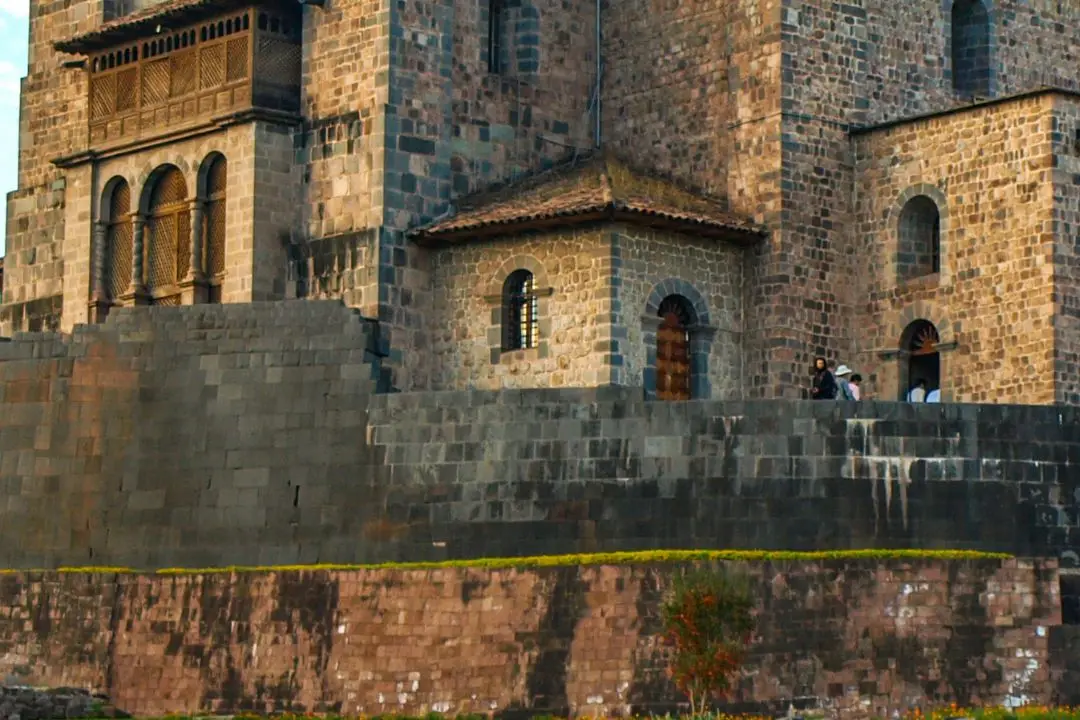
Short answer: Qoricancha (also spelled Coricancha) was the most important temple of the Inca Empire, dedicated to the Sun. It stands in central Cusco, by Avenida El Sol, about a 10-minute walk from the Plaza de Armas. The Spanish built the Santo Domingo church and convent on top of it, so today you see flawless Inca stonework inside a colonial cloister. It has its own entrance ticket, not included in the Cusco Tourist Ticket, and a visit takes 1–1.5 hours. It is the first stop on our private city tour, from US$43 (S/ 150) per vehicle.
What is Qoricancha? A short history of the Temple of the Sun
In Quechua, qori kancha means “golden enclosure”. It was the religious heart of the Inca state: here the Incas worshipped Inti, the Sun, whom they saw as their ancestor, along with other sky deities. Tradition credits the Inca ruler Pachacuti with rebuilding it in the 15th century using the fine masonry you still see today: cut and polished blocks fitted without mortar, with joints you can barely make out. Scholars also note that the ceques, imaginary lines that organized hundreds of shrines around Cusco, radiated from this temple.
The gold the chroniclers described
According to Spanish chroniclers, the walls of the main temple were lined with gold sheets and the garden held figures of plants and animals made of gold and silver. After the Spanish arrived in the 1530s, the metal was stripped and melted down; the same accounts say part of it went toward Atahualpa’s ransom. Only the stone that once held it remains.
The Santo Domingo convent and the 1950 earthquake
After the conquest the complex was handed to the Dominican order, who built the church and convent of Santo Domingo using the Inca walls as foundations. For centuries much of the Inca work was hidden under plaster and colonial additions. The 1950 earthquake badly damaged the colonial building and exposed Inca walls that had held firm. The restoration that followed chose to show both periods side by side: nowhere else in Cusco shows so clearly how one city was built on top of another. The church is still in use.
What to see at Qoricancha
The visit is compact: you enter from the small Santo Domingo square, walk around the cloister and step into the Inca chambers that open off it.
- The inner temples or chambers. Stone rooms that tradition links to the Moon (Killa), the stars or Venus (Chaska), lightning (Illapa) and the rainbow (K’uychi). Exactly which room was which is debated; the quality of the stonework is not.
- Trapezoidal niches and doorways. Openings wider at the bottom than at the top, a classic Inca shape that helped walls survive earthquakes. Look for the double-jamb doorways and the way the walls lean slightly inward.
- The curved wall. Beneath the end of the church sits a curved Inca wall of perfectly fitted stones, visible from inside and, best of all, from outside with the garden in front. It is Qoricancha’s most photographed sight.
- The colonial cloister. A two-story arcaded courtyard built over the temple’s old ceremonial space.
- Paintings and religious art. Colonial religious canvases line the corridors and rooms, many in the style of the Cusco School.
Tickets, opening hours and how long to stay
This is where most visitors get confused: Qoricancha and the area around it are separate visits with separate tickets.
| Visit | What you see | Ticket | Approx. time |
|---|---|---|---|
| Qoricancha and Santo Domingo convent | Inca chambers, niches, the curved wall from inside, cloister and paintings | Own ticket at the door; not in the Cusco Tourist Ticket | 1–1.5 h |
| Qoricancha Site Museum (Museo de Sitio) | Small museum below the garden with archaeological pieces and context | Part of the Cusco Tourist Ticket (Boleto Turístico) | 30–45 min |
| Curved wall and garden from the street | The temple’s exterior seen from Avenida El Sol | No ticket from the sidewalk | 10 min |
You buy the Qoricancha ticket at the main entrance on the Santo Domingo square; bring Peruvian soles in cash in case cards aren’t accepted. It usually opens daily from morning to mid or late afternoon, with shorter hours on Sundays and religious holidays, but prices and hours change, so confirm them locally before you go. The site museum below the garden is a different visit: check what each ticket covers in our Cusco Tourist Ticket guide.
Step by step: how to visit Qoricancha
- Walk from the Plaza de Armas. Head down Calle Loreto, lined with Inca walls, and continue to the Santo Domingo square: under 1 km on a gentle downhill, about 10 minutes. By taxi, ask to be dropped at the square.
- Buy your ticket and decide whether you want a guide (see below).
- Start in the cloister to get your bearings, then go into the Inca chambers around it.
- Find the curved wall from inside and don’t skip the paintings in the corridors.
- On the way out, go down to Avenida El Sol to see the curved wall from outside, the classic photo. If you have the Tourist Ticket, the site museum is in the same area.
- Move on: on foot to the Cathedral and San Blas, or by car up to Sacsayhuamán.
On your own, with a guide or on a private city tour?
There are few information panels, so a good explanation makes a real difference.
| Option | Pros | Cons | Best for |
|---|---|---|---|
| On your own | Full freedom; you only pay the entrance | Little on-site information; easy to miss details | Travelers who have read up on the site |
| Licensed guide hired at the entrance | A tour in your language in about 1 hour | Separate fee agreed on the spot; ask to see their ID card | Anyone who wants the history without booking ahead |
| Viajes D’MARC private city tour | Hotel pick-up; starts here, then Sacsayhuamán and three more sites with no uphill walking | No guide or tickets included; priced per vehicle | Your first days in Cusco, families and groups |
Our tour includes a private vehicle and a local driver. If you’d like a licensed guide for Qoricancha and the Inca sites, message us on WhatsApp and we’ll arrange one separately.
How Qoricancha fits into a day in Cusco
Qoricancha sits at city altitude on almost flat ground, which makes it one of the best visits for your first days. Two ways to plan it:
- Morning on foot, afternoon by car. In the morning, the Cathedral on the Plaza de Armas (separate ticket) and the San Blas neighborhood, walking up Hatun Rumiyoc street to see the twelve-angled stone. After lunch, Qoricancha and then Sacsayhuamán, Q’enqo, Puka Pukara and Tambomachay with the Tourist Ticket.
- Private city tour. That is exactly how our private Cusco city tour works: we pick you up at your hotel after lunch (or in the morning if you prefer), you start at Qoricancha, and your driver then takes you to the four circuit sites, dropping you at each entrance. More in our guide to Sacsayhuamán and Q’enqo.
With more time, our guide to things to do in Cusco covers museums, markets and viewpoints to round out the city. If you are visiting in June, remember that Inti Raymi begins at Qoricancha every June 24, and the Corpus Christi celebrations in Cusco also pack the center: regular visits may change on those days.
Best time to visit, weather and altitude
Cusco sits at about 3,400 m. Qoricancha involves no uphill hiking, but there are steps and you are moving at that altitude, so take it slowly if you have just arrived. Landing in the morning? Book your Cusco airport to hotel transfer, rest for a few hours and leave this visit for the afternoon or the next day.
- Time of day: first thing in the morning brings fewer groups and softer light in the cloister; mid-morning and early afternoon are when most tours overlap.
- Dry season (May to September): clear skies, cold mornings and more visitors, especially in June and July.
- Rainy season (December to March): showers usually arrive in the afternoon. Much of the route runs under the cloister’s covered walkways, so Qoricancha is a good plan for a wet afternoon.
Tips and mistakes to avoid
- Assuming the Tourist Ticket covers it. It doesn’t; carry soles for the door.
- Mixing up the site museum and the temple. The museum below the garden is a separate visit with a separate ticket; check what each ticket covers before you queue.
- Settling for a photo of the curved wall from the avenue. The best part is inside: the chambers, the niches and the contrast with the cloister.
- Using flash or touching the walls. Photos are allowed in parts of the visit, but some rooms, especially those with paintings, may restrict them; follow the staff’s instructions.
- Forgetting it is a working church. Dress modestly, keep your voice down and be respectful if a mass or celebration is on.
- Being careless with your things on Avenida El Sol. It is a busy street; wear your backpack in front in crowds. More advice in our guide on whether Cusco is safe.
Why trust this guide
It is written by Viajes D’MARC’s local drivers, who have been dropping travelers at Qoricancha’s door almost every day since 2010 at the start of each city tour. We know the access points, the real visiting times and the questions our passengers ask most. Updated November 2026.
Frequently asked questions
Is Qoricancha included in the Cusco Tourist Ticket?
No. Qoricancha has its own ticket, paid at the door. The Qoricancha Site Museum below the garden is part of the Tourist Ticket, but it is a separate visit. Check what each ticket covers before you go.
How long do I need at Qoricancha?
Allow 1 to 1.5 hours for the temple and convent. Add the site museum and the view of the curved wall from Avenida El Sol and it comes to about 2 hours.
Where is Qoricancha and how do I get there?
In Cusco’s historic center, by Avenida El Sol, less than 1 km from the Plaza de Armas. It is about a 10-minute walk down Calle Loreto to the Santo Domingo square.
Can I take photos inside Qoricancha?
In parts of the visit, yes, without flash. Some rooms, especially those with paintings, may restrict photography. Follow the staff’s instructions.
Is it worth hiring a guide?
Yes, if you want to understand what you are looking at: there are few panels and many details go unnoticed. Licensed guides usually wait at the entrance; agree the fee first and ask to see their ID.
Does the private city tour include Qoricancha?
Yes, it is the first stop on the Viajes D’MARC city tour, from US$43 (S/ 150) per vehicle with hotel pick-up. The Qoricancha ticket and the Tourist Ticket are paid separately, and the tour does not include a guide.