
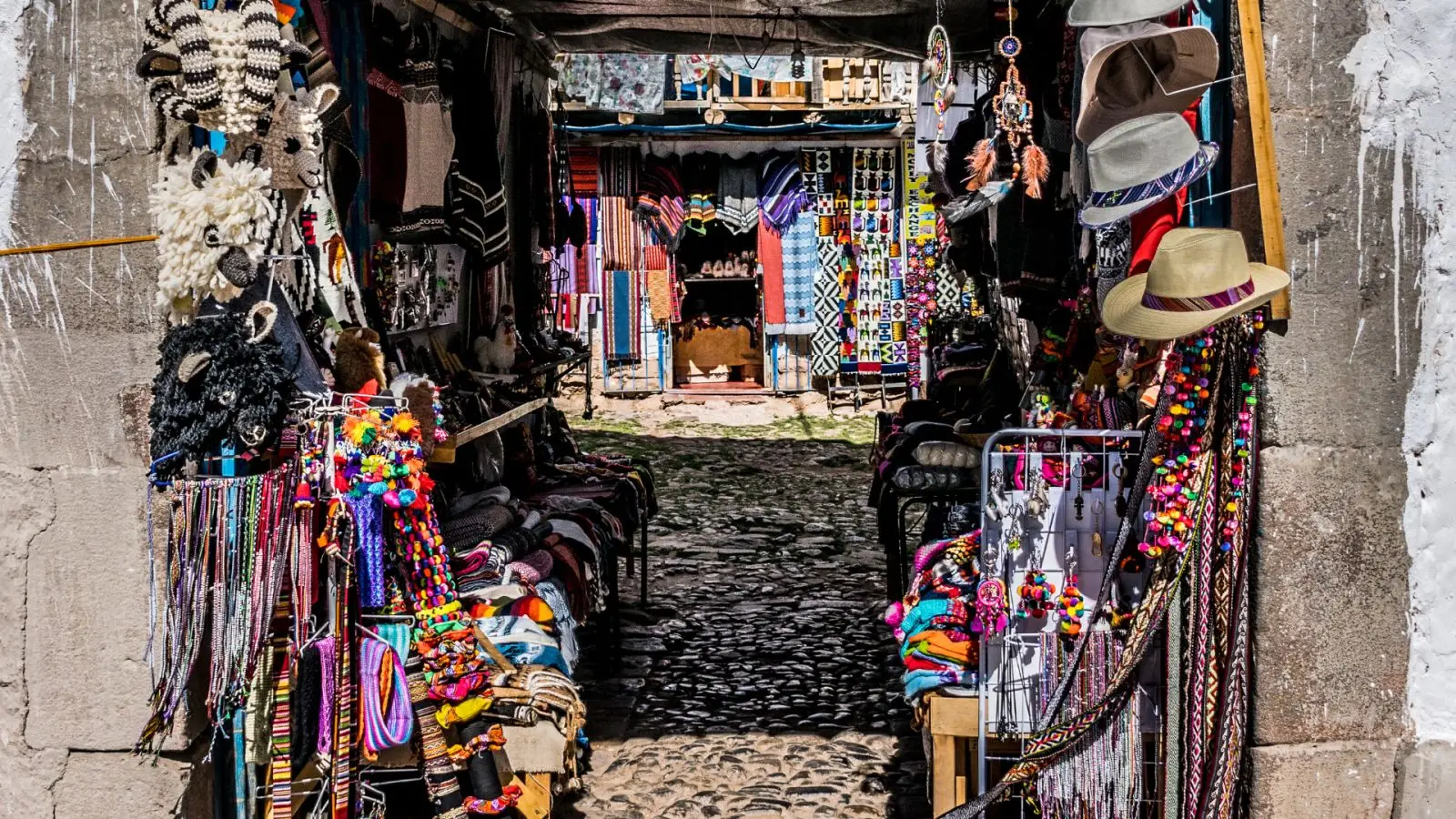
Short answer: The must-dos in Cusco are the historic center (Plaza de Armas, the Cathedral and Qoricancha), the San Blas neighborhood, San Pedro market and Sacsayhuamán; beyond the city, the Sacred Valley (Pisac, Ollantaytambo, Chinchero, Maras and Moray) and Machu Picchu. Three days covers the essentials; with five you can add Rainbow Mountain or Humantay Lake. Start in the Sacred Valley, which is lower, to acclimatize. A Viajes D’MARC private city tour costs from US$43 (S/ 150) per vehicle.
Things to do in Cusco city
The historic center is best explored on foot, but at about 3,400 m every slope counts: take it slowly on your first day.
Plaza de Armas and the Cathedral
This was the great ceremonial square of the Incas and is still the heart of the city, framed by wooden balconies, the Cathedral and the Church of La Compañía de Jesús. The Cathedral, built over an Inca palace, holds a large collection of Cusco School paintings, including a Last Supper with a guinea pig on the table; it has its own entry ticket.
Qoricancha, the Temple of the Sun
This was the most sacred temple of the empire. The Dominicans built the Santo Domingo convent on top of it, so today you see polished Inca stonework and colonial cloisters side by side. Allow about an hour; everything you need is in our Qoricancha guide.
San Blas and the Twelve-Angled Stone
From the square, Hatun Rumiyoc street runs past the famous Twelve-Angled Stone and climbs into San Blas: artisan workshops, steep cobbled lanes, a small church with a carved wooden pulpit and viewpoints over the red-tiled roofs.
San Pedro market
A few blocks southwest of the square is the central market: fresh juice stalls, Amazonian fruit, giant loaves of bread, cheeses, medicinal herbs and home-style food. It is the best window into everyday Cusco; bring soles in small notes and wear your backpack on your front.
Sacsayhuamán and the circuit I sites
On the hill above town, at about 3,700 m, Sacsayhuamán stuns with its zigzag walls of colossal stones. Q’enqo, Puka Pukara, Tambomachay and the Cristo Blanco viewpoint are close by, and all fit into one afternoon. More in our Sacsayhuamán and Q’enqo guide.
Museums
Cusco has museums of pre-Columbian art, Inca history, colonial art and Andean textiles. Several museums and a traditional dance show are covered by circuit II of the Cusco Tourist Ticket; others charge their own entry. They are ideal for your first day or a rainy afternoon.
Our private Cusco city tour combines Qoricancha and the four archaeological sites in one afternoon, with hotel pick-up.
Day trips from Cusco
The classic day trips, from easiest to toughest:
| Trip | Approx. length | Approx. max altitude | Effort | When to go |
|---|---|---|---|---|
| Sacred Valley (Pisac, Ollantaytambo, Chinchero) | Full day | 3,760 m at Chinchero; the valley about 2,900 m | Low | First days |
| Maras and Moray | Half day | 3,500 m | Low | Any day |
| South Valley (Tipón, Pikillaqta, Andahuaylillas) | Half day | Similar to Cusco | Low | Any day |
| Machu Picchu | 1 or 2 days by train | 2,430 m | Moderate | After the valley |
| Humantay Lake | Full day, pre-dawn start | 4,200 m | High | Once acclimatized |
| Rainbow Mountain | Full day, leave around 4:00 a.m. | 5,036 m | Very high | Once acclimatized |
Sacred Valley: Pisac, Ollantaytambo and Chinchero
- Pisac (about 1 hour from Cusco): a craft market in town and one of the largest sets of Inca terraces high on the hill. See our Pisac guide.
- Ollantaytambo: a still-inhabited Inca town below its terraced fortress, with the train station for Machu Picchu. See things to do in Ollantaytambo.
- Chinchero: up on the plateau, a colonial church on Inca walls, terraces and weaving demonstrations. See our Chinchero guide.
The Sacred Valley VIP tour links all three, plus Urubamba, in one day with a vehicle just for your group.
Maras and Moray
The Maras salt mines are thousands of salt pans on a hillside, worked by local families for centuries; nearby Moray is a set of circular terraces the Incas are thought to have used to experiment with crops. Read our Maras guide and Moray guide.
South Valley: Tipón, Pikillaqta and Andahuaylillas
An easy half day southeast of Cusco: the Inca canals and fountains of Tipón, the pre-Inca city of Pikillaqta and the church of Andahuaylillas, famous for its murals. See our Tipón guide and the South Valley tour.
Rainbow Mountain and Humantay Lake
The two most popular high-altitude hikes. Vinicunca, the Rainbow Mountain, tops out at 5,036 m after about 3 hours on the road; turquoise Humantay Lake, under a glacier, involves a short but steep climb to about 4,200 m. Save them for the end of your trip. Read our Rainbow Mountain guide and Humantay Lake guide, or book a private Rainbow Mountain tour or Humantay tour.
Off-the-beaten-path day trips
If you have seen the classics or want places without the crowds: the horn-shaped fortress of Waqrapukara above the Apurímac canyon; the Q’eswachaka Inca rope bridge, rebuilt by local communities every year; the rainbow ridges of Pallay Punchu; the Ausangate 7 Lakes hike; the Lares hot springs and weaving villages; and, half an hour from the city, the giant sculptures of the Abode of the Gods.
Machu Picchu
You take the train from Ollantaytambo or Poroy station to Aguas Calientes, then the bus up to the citadel. Entry tickets have a daily cap. A same-day round trip is possible but exhausting; one night down there is far more comfortable. Everything is in our guide on how to get from Cusco to Machu Picchu.
Cusco itinerary: 3, 4 and 5 days
The logic: on arrival you drop down to the Sacred Valley (about 2,900 m) to acclimatize, continue to Machu Picchu, return to Cusco once your body has adjusted and leave the highest trips for last.
3 days in Cusco
| Day | Morning | Afternoon | Night |
|---|---|---|---|
| 1 | Arrive and transfer straight to the valley, stopping in Pisac | Rest | Urubamba or Ollantaytambo |
| 2 | Early train from Ollantaytambo and visit Machu Picchu | Return train and transfer to Cusco | Cusco |
| 3 | Plaza de Armas, San Blas and San Pedro market | City tour: Qoricancha and Sacsayhuamán | Cusco |
4 days in Cusco
| Day | Morning | Afternoon | Night |
|---|---|---|---|
| 1 | Arrive and transfer to the valley; Pisac market and ruins | Rest | Sacred Valley |
| 2 | Maras and Moray | Ollantaytambo and train to Aguas Calientes | Aguas Calientes |
| 3 | Machu Picchu first thing | Train and transfer to Cusco | Cusco |
| 4 | Plaza de Armas, the Cathedral and San Blas | City tour: Qoricancha and Sacsayhuamán | Cusco |
If you’d rather not organize anything, our 4-day Cusco and Machu Picchu package covers Cusco, the Sacred Valley and Machu Picchu with private transport throughout.
5 days in Cusco
| Day | Morning | Afternoon | Night |
|---|---|---|---|
| 1 | Arrive and transfer to the valley; Pisac | Rest | Sacred Valley |
| 2 | Chinchero, Maras and Moray | Ollantaytambo | Ollantaytambo |
| 3 | Early train and Machu Picchu | Train and transfer to Cusco | Cusco |
| 4 | Plaza de Armas, San Blas and San Pedro | City tour: Qoricancha and Sacsayhuamán | Cusco |
| 5 | Rainbow Mountain or Humantay Lake (pre-dawn start) | Back by mid-afternoon | Cusco |
If you fly out on day 5, swap the hike for the South Valley or the museums.
How to plan your itinerary, step by step
- Book Machu Picchu and the train first: they have limited capacity; everything else fits around those dates.
- Decide where you sleep the first night: in the valley if you can, to acclimatize lower down.
- Book your airport transfer: straight to the Sacred Valley or to your hotel in Cusco.
- Buy the Tourist Ticket on arrival and visit its sites within its validity.
- Leave the high hikes and a free half day for the end.
Cusco festivals month by month
| Month | Festival | What to expect |
|---|---|---|
| February or March | Carnival | Water and foam fights in the streets |
| March or April | Holy Week and the Lord of the Earthquakes | Big procession of Cusco’s patron on Holy Monday |
| May or June | Qoyllur Rit’i and Corpus Christi | An Andean pilgrimage and a procession of saints on the main square; see our Corpus Christi guide |
| June | Inti Raymi (June 24) | The Festival of the Sun, in the most festive month; see our Inti Raymi guide |
| July | Virgen del Carmen in Paucartambo | Days of masked dances |
| December | Santurantikuy (December 24) | Christmas craft fair on the Plaza de Armas |
On the big dates streets in the center close: leave early for the airport or the station.
Altitude, weather and the best time to go
- Altitude: Cusco sits at about 3,400 m. For the first two days eat light and drink water; symptoms and prevention are in our altitude sickness guide.
- Dry season (May to October): clear skies, freezing nights and more visitors from June to August.
- Rainy season (December to March): green landscapes and fewer people, but near-daily afternoon rain. Do your trips in the morning.
- April, May, September and October usually strike the best balance. Full comparison in our best time to visit Cusco guide.
Practical info: tickets, getting around and the airport
- Cusco Tourist Ticket (Boleto Turístico): covers Sacsayhuamán and the nearby sites, Pisac, Ollantaytambo, Chinchero, Moray, Tipón and several museums. It does not include Machu Picchu, Qoricancha, the Cathedral or the Maras salt mines. Ticket types and validity in our Cusco Tourist Ticket guide.
- Getting around safely: the center is safe by day with normal precautions. At night don’t get into unmarked cars on the street; call a taxi, use an app or book one. More in is Cusco safe? and safe taxis in Cusco.
- Airport: about 20 minutes from the center. How to get out, hours and options in our Cusco airport guide.
Tips and mistakes to avoid
- Doing everything on day one: altitude sickness hits hardest when you push yourself right after landing.
- Doing Rainbow Mountain before acclimatizing: 5,036 m is not for day 1 or 2.
- Leaving Machu Picchu until last: in high season tickets sell out weeks ahead.
- Heading out without layers: one day can swing from strong sun to real cold. Bring a jacket, hat and sunscreen.
- Photographing people without asking: ask first; people in traditional dress with llamas in the center usually expect a tip.
Why trust this guide
It is written by the local drivers of Viajes D’MARC, who since 2010 have taken travelers around the city, the Sacred Valley, the train stations and the high-mountain routes every day. We know which order works. Updated November 2026. Tickets, hours and festival dates change, so confirm them before you travel.
Frequently asked questions
What should I do with 3 days in Cusco?
Day 1: arrive and head down to the Sacred Valley via Pisac. Day 2: train to Machu Picchu and back to Cusco. Day 3: San Blas and San Pedro market in the morning, city tour in the afternoon.
How many days do you need in Cusco?
At least 3 days for the city, the Sacred Valley and Machu Picchu. With 4 or 5 you can travel at an easy pace and add Maras, Moray, Rainbow Mountain or Humantay.
Should I visit Cusco or the Sacred Valley first?
The Sacred Valley. It is about 500 m lower than Cusco, so spending your first nights there helps you acclimatize. You can go straight there from the airport.
What can you do for free in Cusco?
Stroll the Plaza de Armas, Hatun Rumiyoc street and San Blas, climb to the viewpoints, browse San Pedro market and catch the parades and processions if they coincide with your trip.
Can you visit Machu Picchu as a day trip from Cusco?
Yes, with an early train and an afternoon return, but it makes for a day of 14 hours or more. If you can, spend a night in Aguas Calientes or the valley.
How much is a private city tour in Cusco?
With Viajes D’MARC, from US$43 (S/ 150) per vehicle, with hotel pick-up. The price is per vehicle, not per person; entry tickets are paid separately.