
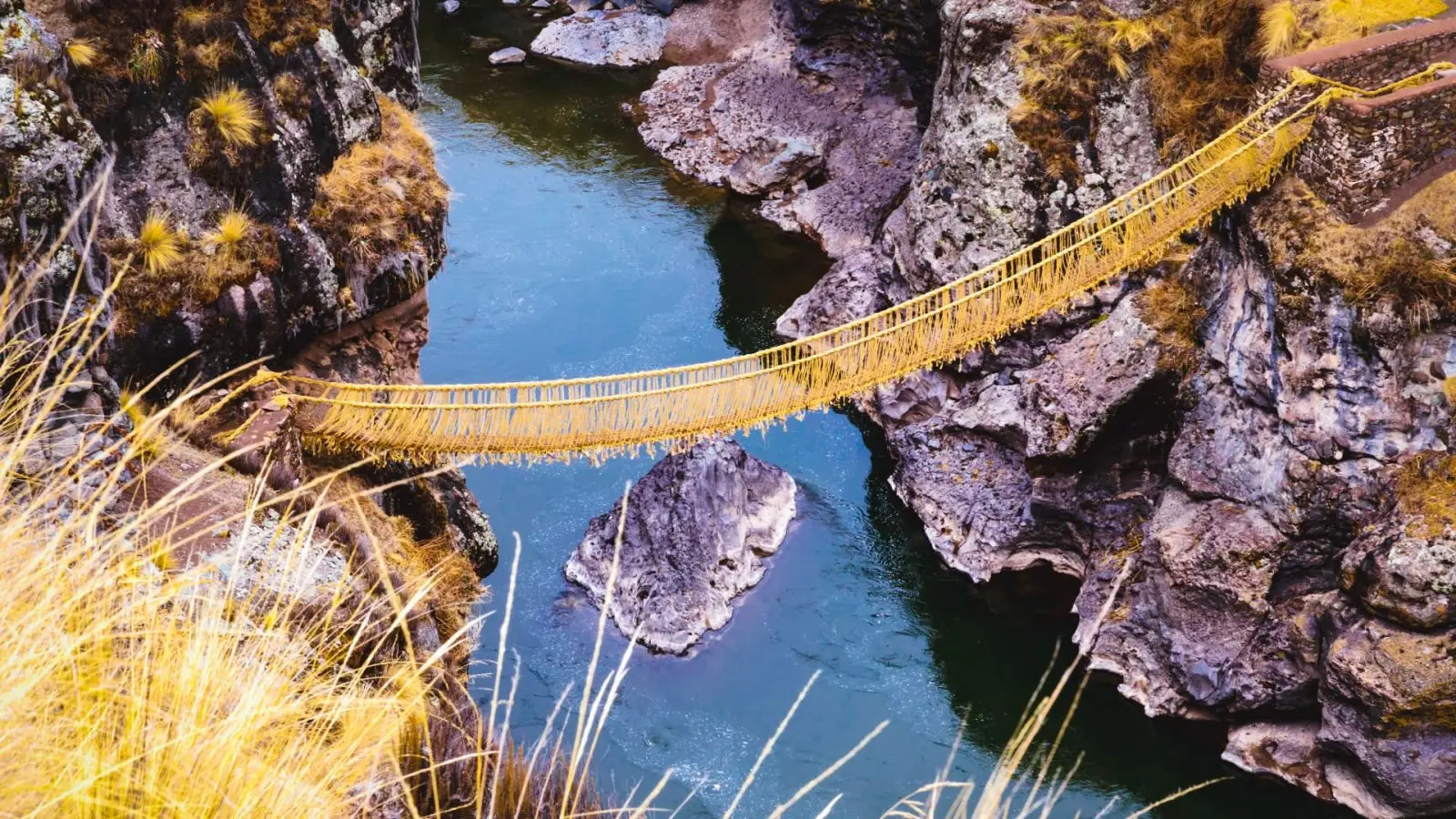
Short answer: The Q’eswachaka bridge is the last Inca rope bridge still in use: about 28 m (92 ft) of woven grass rope over the Apurímac river at approx. 3,700 m (12,100 ft), in Quehue district, Canas province, south of Cusco. Local communities rebuild it every year, usually in June, a tradition recognized by UNESCO in 2013. It is about 160 km from Cusco, approx. 3.5 to 4 hours each way via the Cusco–Sicuani highway, so a tour or private vehicle is the practical option. A private tour with Viajes D’MARC costs from US$114 (S/ 400) per vehicle.
What the Q’eswachaka bridge is
Q’eswachaka (also spelled Qeswachaka or Keswachaka) comes from Quechua and roughly means “bridge of braided rope”. It is a suspension bridge about 28 m long and 1.2 m wide across a gorge of the Apurímac river. It was part of the Qhapaq Ñan, the Inca road network, and it is the last bridge of its kind still built with the original technique and materials, which is why it is called the last Inca bridge.
It is made from q’oya, a high-altitude grass that families twist into thin cords. These are braided into medium ropes and then into six thick cables: four form the floor and two serve as handrails, joined by woven side walls and tied to ancient stone anchors on each side of the gorge. Because the grass rots with rain and use, the bridge lasts roughly a year.
In 2009 the Peruvian state declared the renewal ritual and its knowledge part of the Cultural Heritage of the Nation, and in 2013 UNESCO inscribed them on the Representative List of the Intangible Cultural Heritage of Humanity. What is recognized is not just the object but the living practice: communal work (minka and ayni), offerings, and skills passed from parents to children.
The annual renewal: when it happens and what you will see
The bridge is rebuilt once a year, usually in June, over three or four days of community work. The communities of Huinchiri, Chaupibanda, Choccayhua and Ccollana Quehue, the four named by UNESCO, take part, and in recent years other neighboring communities of Quehue have joined; the press speaks of around a thousand people. The communities agree the dates with the Quehue municipality and announce them each year. For reference, in 2025 the new bridge was handed over on Saturday 7 June, and in 2026 the activities ran from 11 to 14 June.
Broadly, the sequence is:
- Offerings and ropes: an Andean priest (paqo) makes an offering to Pachamama and the apus, the mountain spirits. Each family brings its twisted q’oya cords and the big cables are braided.
- Stringing the cables: the old bridge is cut loose and falls into the river, and the new cables are stretched from bank to bank.
- Weaving: the master builders (chakaruwaq) weave the floor and handrails from each end until they meet in the middle.
- Festival: music, dancing and food, and the bridge reopens to walkers.
Seeing the renewal is unforgettable, but it gets very crowded and you cannot cross while work is under way. If you want to be there, message us early and confirm the dates a few weeks ahead. The tradition is fragile: in 2021, after a year without renewal because of the pandemic, the bridge collapsed and was rebuilt, and in May 2025 it was deliberately damaged and had to be renewed in June.
How to get to the Q’eswachaka bridge from Cusco
The bridge is about 160 km south of Cusco. The usual route follows the Cusco–Sicuani highway (the same road as the Ruta del Sol to Puno) along the Vilcanota valley, past Urcos, to the Combapata area; from there it climbs onto the Canas plateau through Yanaoca and Quehue to the Apurímac canyon. By car it takes approx. 3.5 to 4 hours each way. Many travelers go or return via the Four Lakes route. From the road it is a few minutes’ walk down to the bridge.
Shared tour
Several Cusco agencies sell it, though many run only on certain days of the week or once they fill a group. They leave before dawn, combine the bridge with the lakes and often include lunch. It is the cheapest option per person, but time at each stop is fixed. Ask whether the entrance fee and a guide are included.
Private tour
A vehicle and driver only for your group, with hotel pick-up at the time you choose. You decide how long to spend at each lake and at the bridge, and can arrive before the groups. The price is per vehicle, so it works best for couples, families and groups. That is what we run as our private Q’eswachaka bridge tour.
Public transport
Possible but slow: a bus from Cusco toward Sicuani as far as Combapata (approx. 2 hours), a colectivo to Yanaoca (approx. 30 minutes) and another to Quehue (approx. 50 minutes). There is no regular transport from Quehue to the bridge, so you will need to hire a local car. Colectivos leave when full and thin out in the afternoon, which makes a same-day round trip very tight.
| Option | Approx. time from Cusco | Pros | Cons | Best for |
|---|---|---|---|---|
| Shared tour | Full day, pre-dawn start | Low price per person, all organized | Not daily, fixed schedule | Solo travelers on a budget |
| Private tour | 3.5 to 4 h each way, at your pace | Hotel pick-up, stops when you want, driver waits | Price is per vehicle | Couples, families, groups and photographers |
| Public transport | 4 to 5 h or more, 3 changes | Cheapest | Irregular times, no transport on the last stretch | Backpackers with spare days |
The Four Lakes route and other sights nearby
On the way to the bridge you can drive the Four Lakes route (Cuatro Lagunas): Pomacanchi, the largest, Acopia, Asnaqocha and Pampamarca. They are high-altitude lakes, somewhat higher than Cusco, ringed by hills, farmland and villages with colonial churches. In the morning light the water mirrors the sky. This is also the homeland of Túpac Amaru II, chief of Pampamarca and Tungasuca, who won the first major battle of his 1780 rebellion at Sangarará.
In the same province of Canas are the colorful ridges of Pallay Punchu, and further north the sanctuary of Waqrapukara. If you are heading on to Lake Titicaca, read our Cusco to Puno guide. For more ideas, see things to do in Cusco.
Step by step: a day trip to Q’eswachaka from Cusco
- Early start (approx. 5:00 to 6:00 am). Hotel pick-up and the drive south along the Vilcanota valley.
- The lakes. After about 2.5 hours the lakes begin; allow 15 to 30 minutes per stop.
- Reach the bridge by mid-morning. Pay the entrance fee at the checkpoint and walk down to the riverbank.
- At the bridge. Look at it from both sides, see how the cables are tied to the stone anchors and decide whether to cross. 45 minutes to an hour is enough.
- Climb back and return. The walk up is short but noticeable at this altitude. Have lunch on the way and reach Cusco by mid-afternoon.
Altitude, weather and the best time to go
The bridge sits at approx. 3,700 m, about 300 m higher than Cusco (approx. 3,400 m / 11,150 ft). The walk is short, but the climb back can leave you breathless if you are not acclimatized: spend one or two days in Cusco or the Sacred Valley first, and read our guide to altitude sickness in Cusco.
- May to September (dry season): clear skies, bright lakes and very cold mornings, often below freezing. The June renewal falls in this period.
- December to March (rainy season): the river rises, the path gets slippery and the bridge, after months of use, is more worn. It can still be visited, with extra care.
June is also the month of Inti Raymi, so book early if you travel then. To plan your trip around the weather, see our guide to the best time to visit Cusco.
What to bring and the entrance fee
- Layers and a windproof jacket: mornings are cold and the midday sun is strong.
- A hat, sunglasses and high-factor sunscreen.
- Shoes with good grip: the path to the river has loose dirt.
- Cash in soles, in small notes; do not count on ATMs near the bridge.
Visitors pay an entrance fee collected by the local community or municipality. It is modest, but the amount changes from year to year, so confirm it on site. It is not included in the Viajes D’MARC private tour. For a full list, see our guide to what to pack for Cusco.
Tips and mistakes to avoid
- Going the day after you fly in: acclimatize first, even though this is a gentle trip.
- Assuming the renewal date: it changes every year, so confirm it before you fix your itinerary.
- Crossing carelessly: the bridge sways a lot. Cross a few people at a time, hold the handrails and respect any restrictions set by the community. If you suffer from vertigo, enjoy it from the bank.
- Stacking it with another high-altitude trip: do not do it the day before Rainbow Mountain.
- Forgetting it is a sacred place: do not pull fibers from the bridge, carry out your trash and ask before photographing people.
Why trust this guide
It is written by the local drivers of Viajes D’MARC, who have driven the routes south of Cusco every day since 2010. We know the road to Quehue, the real driving times and how the bridge changes through the year. Updated November 2026. Renewal dates, entrance fees and third-party schedules change: confirm them before you go.
Frequently asked questions
Where is the Q’eswachaka bridge?
In Quehue district, Canas province, Cusco region, spanning the Apurímac river about 160 km south of Cusco city, at approx. 3,700 m (12,100 ft).
When is the Qeswachaka bridge rebuilt?
Every year, usually in June, over three or four days. The communities and the Quehue municipality set the dates; in 2026 it ran from 11 to 14 June. Confirm them before you travel.
Can you walk across the Q’eswachaka bridge?
Usually yes, carefully and following the instructions of community members, as it sways quite a bit. You cannot cross during the renewal, and crossing may be restricted when the bridge is very worn.
How much is the entrance fee?
A modest fee is paid in cash to the local community or municipality. The amount changes, so confirm it on site. It is not included in the Viajes D’MARC private tour.
How long does it take to get there from Cusco?
Approx. 3.5 to 4 hours each way by car, a bit more if you stop at the Four Lakes. By public transport, with three changes, 4 to 5 hours or more.
Why is it called the last Inca bridge?
Because it is the last rope bridge still woven every year with Inca techniques and materials on a Qhapaq Ñan crossing, kept alive by an unbroken community tradition.
How much is a private Q’eswachaka tour?
With Viajes D’MARC, from US$114 (S/ 400) per vehicle, not per person, including hotel pick-up, stops at the lakes and a driver who waits. The entrance fee, a guide and meals are extra.