
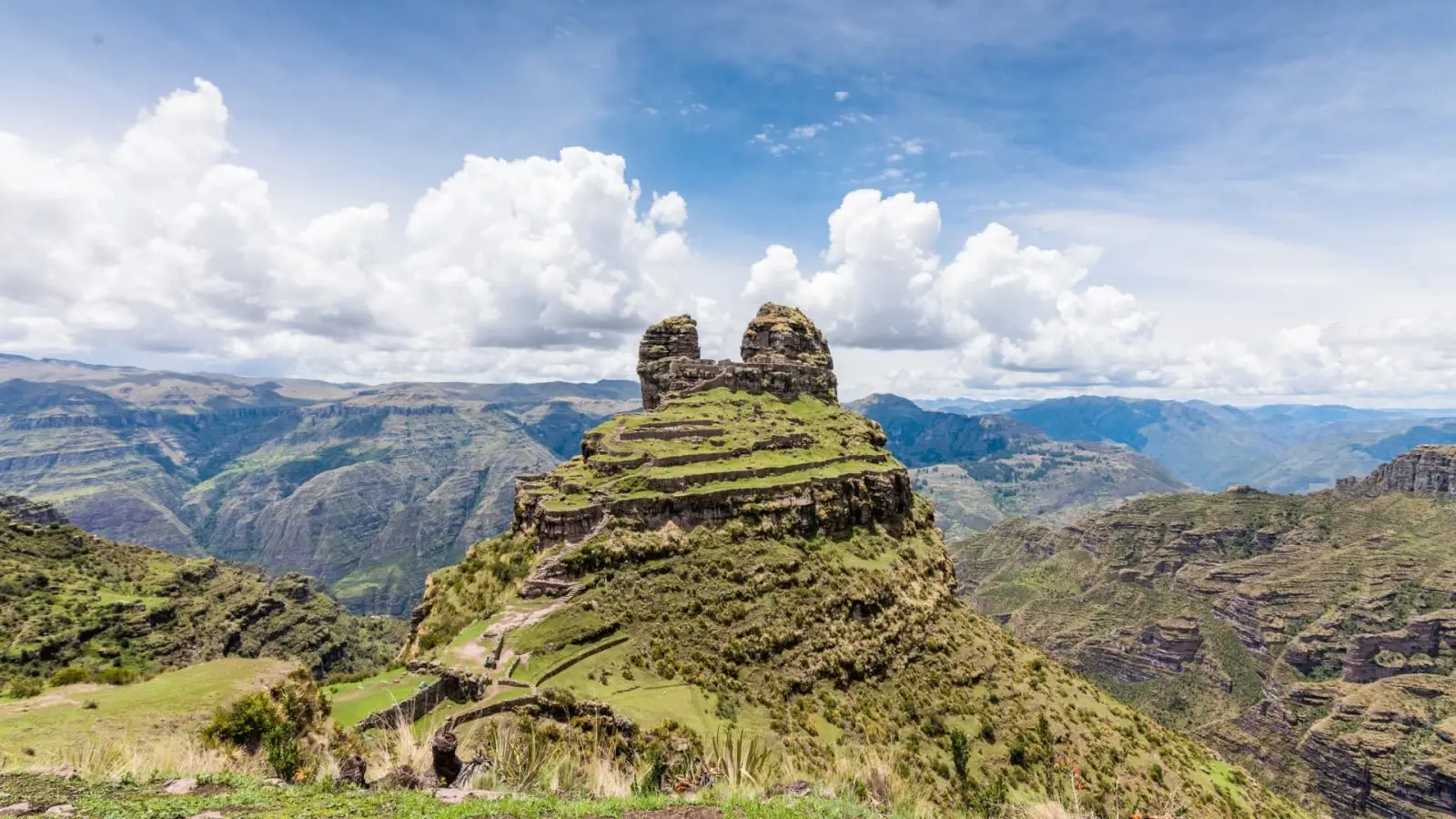
Short answer: Waqrapukara is an Inca and pre-Inca sanctuary built on a rock with two horn-shaped spires, at about 4,100 to 4,140 m (13,450 to 13,580 ft), on the edge of the Apurímac canyon in Acomayo province, Cusco. From Cusco you drive south on the road to Sicuani and then on rural roads to the trailhead (approx. 3 to 3.5 hours), then hike about 2 hours. No public transport reaches the trail: a private tour with Viajes D’MARC costs from US$114 (S/ 400) per vehicle, with hotel pick-up.
What Waqrapukara is and why it is special
In Quechua, Waqrapukara means “horn fortress” (waqra is horn and pukara is fortress), after the two rock spires that crown the hill; some archaeologists think they actually represent a llama’s ears. On and around that formation you will find enclosures, walls, terraces, niches and double- and triple-jamb doorways, a type of entrance the Incas reserved for places of great religious importance.
Rather than a military fort, researchers see it as a ceremonial center with a long history: it was probably a sacred place of the Qanchi people before the Incas absorbed it into their empire and rebuilt it. Most of what you see today is Inca architecture. Peru declared it a Cultural Heritage of the Nation in 2017, and it has been gaining a following among travelers who have already seen the classics.
- The setting: the sanctuary looks over the Apurímac canyon, with near-vertical slopes hundreds of meters below.
- Few visitors: it is not on the mass-tourism circuit, so you may well have it almost to yourself.
- The journey: high puna grassland with llamas and alpacas, farming communities and Andean lakes such as Pomacanchi.
How to get to Waqrapukara from Cusco
Waqrapukara lies in the district of Acos, Acomayo province, southeast of Cusco city. The route leaves Cusco on the road to Sicuani (the highway to Puno), passes Urcos and follows the Vilcanota valley. Near the Chuquicahuana bridge you leave the main road and climb toward Acomayo and Pomacanchi on rural roads, partly unpaved. Allow approx. 3 to 3.5 hours to the trailhead, a bit more with a breakfast stop or if rain has damaged the road. No vehicle reaches the sanctuary itself: the last part is always on foot.
Hiking routes
- From Santa Lucía (Pomacanchi side): the most popular route for a day trip. About 2 hours each way across the puna, with near-flat stretches, some zigzags and a short, steep final climb.
- From Huayqui or Campi (Acos side): the canyon route, steeper, approx. 2 to 3 hours uphill with views of the Apurímac river.
- From Sangarará and other high routes: hikes of approx. 4 to 5 hours, better suited to a two-day trek with camping.
Times depend on your pace and acclimatization. Signage is scarce and phone signal patchy, so go with someone who knows the trail or download an offline map before you set off.
Shared tour, private transport or on your own
Shared tour: a few Cusco agencies sell it, with fewer departures than to the big-name sights. You usually travel in a group with a guide and fixed times. Private transport: a vehicle and driver just for your group, with hotel pick-up and a driver who waits for the whole hike; that is what we run as our private Waqrapukara tour. On your own: buses run from Cusco to Acomayo and Pomacanchi (ask at your hostel for the current departure point), but no regular public transport reaches the trailheads. You will need to hire a local car, and with bus times a same-day round trip is close to impossible.
| Option | Leaves Cusco | Pros | Cons | Best for |
|---|---|---|---|---|
| Shared tour | Fixed time, before dawn | Per-person price, guide and logistics sorted | Few dates, group pace, little flexibility | Solo travelers |
| Private transport | Whenever you choose | Hotel pick-up, your pace, driver who knows the rural roads | Price is per vehicle; a guide is arranged separately | Couples, families and groups |
| On your own | Depends on buses to Acomayo | Cheapest, lets you sleep in the area | Several changes, local car to the trail, near impossible in a day | Backpackers with 2+ days |
Step by step: a day at Waqrapukara
- Leave before dawn. Hotel pick-up is very early so you reach the trail in good light and get back before dark.
- Breakfast on the way. There are small towns in the Vilcanota valley, or bring your own.
- Puna and lakes. After leaving the main road, the drive climbs through grassland past Pomacanchi lake, a good photo stop.
- Trailhead. Pay the community entrance or access fee in cash. Your driver waits here.
- The climb (about 2 hours). Walk slowly, with short breaks and plenty of water. The last stretch is steep with loose stones.
- The visit (approx. 1 hour). Explore the terraces, the doorways and the viewpoints over the canyon. Do not climb on walls or carved rocks.
- The return. Going down is a little quicker; plan on about 4 hours away from the vehicle in total and reaching Cusco in the late afternoon.
Altitude, difficulty and acclimatization
Cusco sits at about 3,400 m (11,150 ft). On this trip you spend the whole day above 3,800 m and finish above 4,100 m. The Waqrapukara hike is moderate: there are no technical sections, but there are ups and downs in thin air.
- Acclimatize for at least 1 to 2 days in Cusco or, better, in the lower Sacred Valley before you go.
- Warning signs: a strong headache, nausea, dizziness or unusual exhaustion. Stop and go down. Our guide to altitude sickness in Cusco explains how to prevent it.
- See your doctor first if you have heart or breathing conditions, high blood pressure or are pregnant.
Harder than Rainbow Mountain? No: Vinicunca tops 5,000 m, while Waqrapukara stays around 4,100 m. The difference is that here there are fewer people and almost no services on the trail, so come well prepared. Compare with our Rainbow Mountain guide.
Best time to visit Waqrapukara
- May to September (dry season): clear skies and the best views over the canyon. Mornings are very cold, sometimes below freezing.
- April and October (shoulder months): a good balance; afternoon showers are possible.
- December to March (rainy season): the trail and access roads get muddy and fog can hide the views. It is doable, but keep your plans flexible.
In any month the sun is strong at this altitude, and mornings are usually clearer than afternoons. To plan your whole trip around the weather, see our guide to the best time to visit Cusco.
What to bring, entrance fee and services
- 1.5 to 2 liters of water and food for the whole day: there are no shops on the trail.
- Layers, a rain jacket, a sun hat and a warm hat, gloves, sunglasses and high-factor sunscreen.
- Hiking shoes or boots with good grip and, if you have them, trekking poles.
- Cash in soles, in small notes; do not count on ATMs or card payments in the area.
- Toilet paper, personal medication and a bag to carry out your trash.
Entrance fee: Waqrapukara is not part of the Cusco Tourist Ticket (Boleto Turístico). The local community charges an entrance or access fee that changes over time, so confirm it on site and bring cash. Services: there are hardly any toilets or shops near the site. A guide makes a real difference in understanding what you see; if you want one, ask us on WhatsApp when you book. For more ideas, see our Cusco packing list.
How to fit Waqrapukara into your trip
It is a long, demanding day, so do not stack it with another high-altitude outing. Go once you are acclimatized and leave an easy day before your next mountain. If southern Cusco appeals to you, on other days you can visit the Q’eswachaka Inca bridge, Rainbow Mountain or the quieter Palcoyo mountain. For more plans, read our guide to things to do in Cusco.
Tips and mistakes to avoid
- Going before you acclimatize: hiking the day after you fly into Cusco ruins more days than anything else.
- Hiking without knowing the trail: there are several paths, little signage and few other hikers to ask.
- Leaving Cusco late: the drive is long, and you want to hike in daylight and be back before dark.
- Carrying too little water or food: there is nowhere to buy anything near the sanctuary.
- Trying to add Q’eswachaka or Rainbow Mountain on the same day: each is a full day on its own.
- Climbing on walls or moving stones: it is a protected archaeological site and sacred to local communities.
- Booking informal transport: on rural roads, who drives and in what vehicle matters. More advice in our guide to staying safe in Cusco.
Why trust this guide
It is written by the local drivers of Viajes D’MARC, who have driven the roads of southern Cusco every day since 2010. We know the state of the rural roads toward Acomayo and how long the journey really takes. Updated November 2026. Third-party fees, schedules and conditions change: confirm them before you go.
Frequently asked questions
Where is Waqrapukara?
In the district of Acos, Acomayo province, southeast of Cusco city, above the Apurímac canyon. You reach it via the road to Sicuani and then rural roads, in approx. 3 to 3.5 hours.
How long is the Waqrapukara hike?
From Santa Lucía, the most popular route, it is about 2 hours each way, a little less on the way back. The canyon route from Huayqui or Campi is steeper, and the route from Sangarará takes 4 to 5 hours.
How high is Waqrapukara?
About 4,100 to 4,140 m (13,450 to 13,580 ft) above sea level, depending on the source. Cusco is at about 3,400 m, so arrive acclimatized.
How much is the Waqrapukara entrance fee?
It is not included in the Boleto Turístico. The local community charges a cash entrance or access fee that changes, so confirm it on site. It is not included in the Viajes D’MARC private tour.
Can I get to Waqrapukara by public transport?
Only partly: buses run from Cusco to Acomayo and Pomacanchi, but not to the trailhead. You need a local car, and with bus times most independent travelers spend a night in the area.
Can I combine Waqrapukara with Q’eswachaka or Rainbow Mountain in one day?
It is not recommended. They are all south of Cusco, but each already takes a full day with a pre-dawn start. Do them on separate days.
How much is a private Waqrapukara tour from Cusco?
With Viajes D’MARC, from US$114 (S/ 400) per vehicle, not per person, with hotel pick-up and a driver who waits. The entrance fee, a guide and meals are not included; a guide can be arranged on WhatsApp.